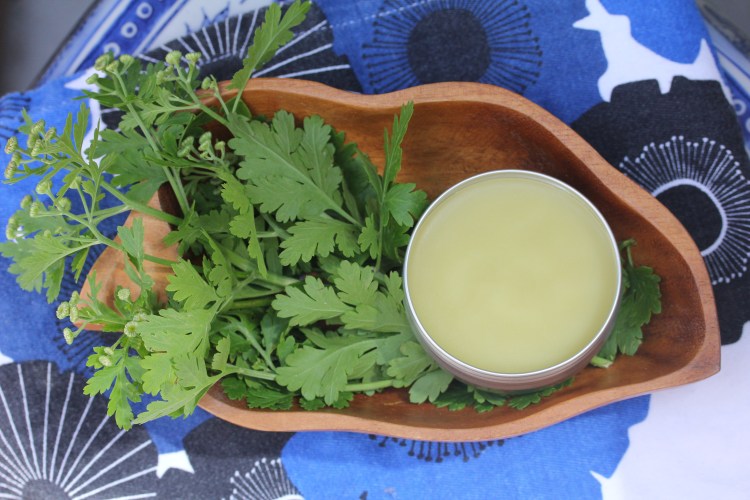
We have had an atypical amount of rain this June. There is minor street and underpass flooding most afternoons. I am anxiously watching the water table and creek levels hoping that we don’t have a repeat of the 2013 100 year flood. I have never see the foothills so green nor the rural fields and roadways so lush with growth. It has been too wet and cool to harvest anything. It just molds or ferments in my drying baskets. I lost this years harvest of dandelion leaves. I never fully appreciated the advantages of living in a hot and dry climate. The herbs dry so quickly and effortlessly. Rarely requiring me to use the dehydrator. Many of my medicinal plants are already over my head. It will be hard to plan this herbal year as both me and the plants are getting behind. I expect a bumper crop of mosquitos this year, biting at all times of the day and night. This salve will come in handy.
I made an infused oil using equal parts of fresh chamomile, mugwort, yarrow, calendula, feverfew, hops, lemon balm, lavender, coriander, plantain, thyme, sage, basil, and echinacea. Herbs know for their healing, cooling, anti-microbial, bug repelling and soothing properties. This oil is my base. It will be used in my basic salve recipe.
Basic Salve Recipe
I start with one cup of infused oil. I use organic US grown olive oil as it produces a more reliable result. Next pack a 16 0z. jar with clean, dry leaves if using fresh. Do not crush or macerate the leaves during processing to avoid releasing water into your infusion. Fill the jar to the rim with oil, making sure no plant material has risen above the oil. If so it can be poked down gently using a knife or chopstick. Screw the lid on tightly and set the jar on a saucer in case there is expansion. Let set exactly 2 weeks before straining.
Next you will need
2-3 ounces of beeswax pellets
1 oz of shea butter
Add your strained oil infusion to a double boiler. Heat on medium for 5 minutes. Add in the 2 ounces of beeswax and all of the shea butter. As soon as it is all melted and you see no floating pellets-test consistency by dipping a metal spoon into the mixture and placing it in the freezer for 1 minute. If you are happy with the result remove from the heart. If not, add beeswax and test until you are satisfied. Let cool 2 minutes . Pour into small tubes, tins or jars. Let sit 2 hours before capping and storing. If you add about a TBSSP of castor oil as you are melting it gives your salve a more silky texture.
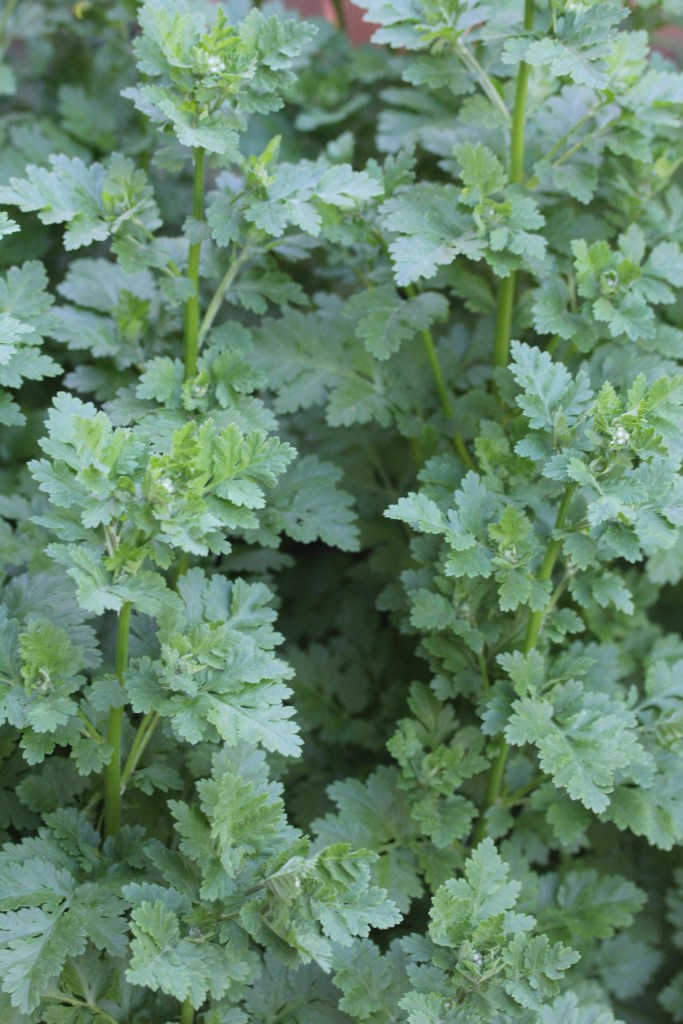
I have been growing Tanacetum for decades but rarely used it for medicine. The plant has lovely flowers which dry nicely for bouquets and it fills out an area nicely. You can find this plant in gardens and abandoned lots. It is in the Compositae/Aster family. Subfamily Anthemideae/Chamomile. Do not confuse it with Tanacetum vulgare (Tansy). Feverfew has light green feathery leaves arranged alternately on a round stem. It grows 6-18 inches high. The plant has a strong distinctive smell that is not quite pleasant. The flowers look like small daisies with white “petals” and a yellow center, If self seeds and spreads easily. It is not too invasive if you remove dead flower heads. Feverfew will grow in any type of soil and in most locations. It looks great for most of its season as a hardy perennial.
It is a mystery to me why more herbalists do not use this plant. It has been used to treat inflammation, digestive issues, allergies, arthritis, nausea, spasms (menstrual and muscle), asthma attacks, depression, menstrual problems, fever, flu, and colds. Externally is can be used to heal bruises or soothe insect bites. It is one of the first herbs to get a scientific study. Feverfew is best known as a very effective preventative strategy for migraines. As a compress it can relieve a headache. In a spray it can be part of a formula for a bug repellant. It is worth paying attention to feverfew right now because it prevents blood from clotting and inhibits the the release of inflammatory substances from the cells. It is also a powerful anti-microbial.
Latin name: Tanacetum parthenium
Plant family: Compositae/Aster/daisy
Parts used: leaves and flowers
Energetics:sweet, warm, moist
Element:fire
Emotional/Spiritual Uses: cleansing
Contraindications and Cautions: may cause mouth sores ,irritate the stomach or cause dermatitis in rare cases. Avoid during pregnancy and nursing. Do not consume if you are taking blood thinners, have a surgery planned or are allergic to plants in the ragweed family.
 Blackbird's Backyard Pharmacy