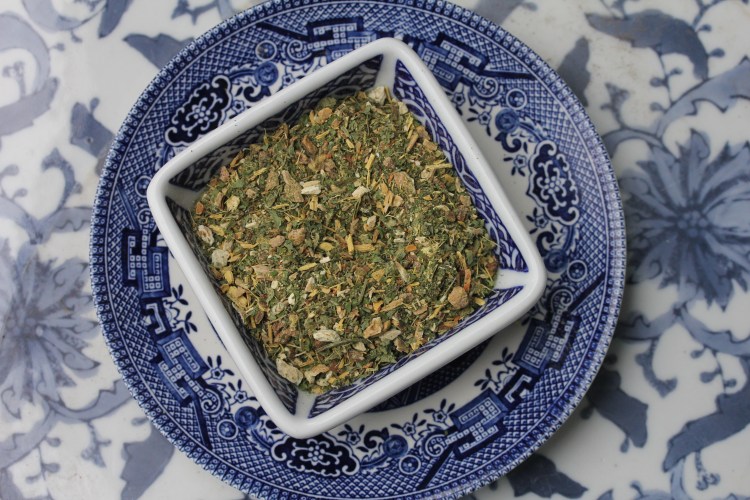
I have been growing a single valerian plant in my garden for years. I purchased it as a start from a source that no longer exists. I don’t know how easy it would be to grow it from seed if I had too. I rarely have luck with medicinals that way, having better success with transplants. I recall reports of myself and others having too strong of a reaction (intense dreams) to valerian. Instead of a tincture of the fresh root, this tea makes use of the leaves to lower the dose of chemical constituents and energetics.
Valerian brings to mind the neighborhood cats who tried to dig up the roots decades ago, exposing them to air and sunlight. The unpleasant scent released being attractive to many animals. Those felines don’t even bother the catnip anymore, let alone my valerian which now stands neglected in a corner of my yard. It has always been a small plant. I am surprised it comes back each year. It is not lush with growth due to all the rain we have had, unlike its neighbors. Either I planted it in the wrong spot or it is failing to thrive because I give it so little thought, appreciation, and don’t really have a use for it. I don’t really like to harvest my plants for their roots. I was excited to come up with this formula for a lung tea as it uses the leaves of the valerian plant.
This tea has equal parts of dried and processed-licorice root, ginger root, mint leaves, elecampane root, anise hyssop leaves , mullein leaves, horehound, marshmallow root, and valerian leaves. Plants known to cool, soothe, move stagnation, loosen phlegm, relax muscles/spasms and stop those coughing fits that prevent sleep.
To make it you need to bring two cups of water to a roaring boil, add in 2 TBSP of the tea mixture. Reduce the heat to a low temperature and simmer 15 minutes before straining and consuming. Using a lid on the pot will help hold in some of the volatile oils that will be lost.

Latin name: Valeriana officinallis
Plant family: Valerianaceae
Parts used-most often the root, sometimes the leaves
Energetics: spicy/pungent, bitter, warming, sweet, dry
Element: air
Emotional/spiritual uses: supports self reflection without pity or judgment. Allows us to focus on our self worth and value during difficult periods where we might feel guilt, shame, or regret.
Contraindications: best avoided in people who have a “heat” condition or are “overexcited” in their presentation. Large doses it can cause headache, hallucinations, nausea, agitation or lethargy, and the inability to control movements. A small number of people have disturbing dreams or feel wired with its use. If this happens it should be discontinued. Do not use if you are have low blood pressure or hypoglycemia. Should not be used by individuals taking sedatives or tranquilizers, medicine for low blood pressure or anxiety. Not considered safe during pregnancy or internally for children under the age of three. Some believe prolonged use causes addiction. Use caution if operating heavy/dangerous machinery or when driving.
This plant can be found growing in damp places like low lying meadows, woods, marshes, swamps, and along the banks of rivers or lakes. It is a tall perennial with a few, erect hollow stalks that are round and thickly furrowed. True valerian is topped with umbels of small, white flowers that smell like vanilla. These have five petals which join to form a calyx. Cymes/compound inflorescences are set at the ends of long pairs of stems set at right angles. The oddly pinnate leaves are made up of coarsely serrated, divided, lance shaped leaflets that are opposite. Leaves are long stemmed and wrap around the stalks as broad sheaths at the base. The rootstock (rhizomes and stolens) smell like sicky sweet “dirty socks”, especially when dried or freshly tinctured. These are grayish brown and short in length.
Valerian is useful as an antispasmodic and to calm/sedate. Historically it has treated back pain, neuralgia, sciatica, earache, depression, restlessness, epilepsy, insomnia, stress, anxiety, panic attacks/PTSD, nervous heart conditions, fatigue, heart palpitations, high blood pressure, spams of the respiratory and digestive systems, ulcers, diarrhea, gas, colic, gastric reflux/vomiting, IBS, epigastric spasm, migraines, rheumatism, menstrual cramps, tight muscles, PMS, parasites, poor appetite, tension, coughs, colds, flu, fever, arthritis, and gout. Some people have used it during the day to increase performance, focus, and memory. It is great in a bath or steam especially for children when there is nervous exhaustion. In some cultures the root is used in food.
 Blackbird's Backyard Pharmacy