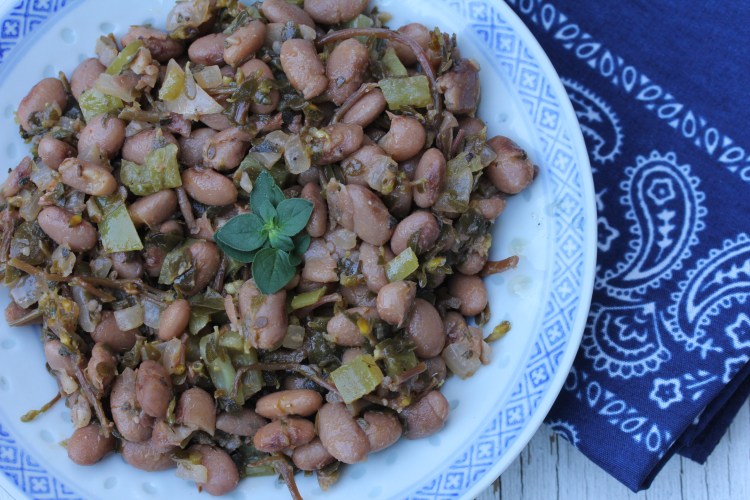
Pinto Bean, Purslane and Oregano Salad

I have a bumper crop of oregano this year. Homegrown fresh or dried oregano tastes so much better than anything you could ever buy in a store. Purslane also grows in my garden in great abundance. Highly invasive but also high in nutrients like Omega Fatty Acids and vitamins A, C, and E. Thankfully it is pretty easy to remove. This recipe is inspired by Georgia O’Keefe’s cookbook, written when she lived in the Southwest. Oregano is a common ingredient in many global cuisines. The Greeks and Spanish have paired this herb with purslane for centuries. In the US purslane is an “emergency” food for some but in a harsh environment foraged regularly by Indigenous people. It is unknown how it reached the Americas before colonization. Purslane is both salty and sour, a bit slimy like okra. This salad is great cold or heated and served with eggs for breakfast. My recipe is vegan but traditional ones probably contained pork. I replaced that protein with pinto beans.

Purslane, Pinto Bean, and Oregano Salad

For the dressing combine in a small bowl….

Juice of 1 small lemon

3 TBSP of olive oil

1 tsp of ground cumin

1 tsp of ground coriander

1 tsp paprika

salt and pepper to taste. Set aside

In a medium frying pan saute……….

1 medium anaheim chile with veins and seeds removed-coarsley chopped

1/2 small onion

1-2 cups of loosely packed fresh purslane, washed and roots removed

3 cups of cooked pinto beans

Once cooled to room temperature, place in a bowl or dish, add the dressing and stir. Chill 1 hour before serving.
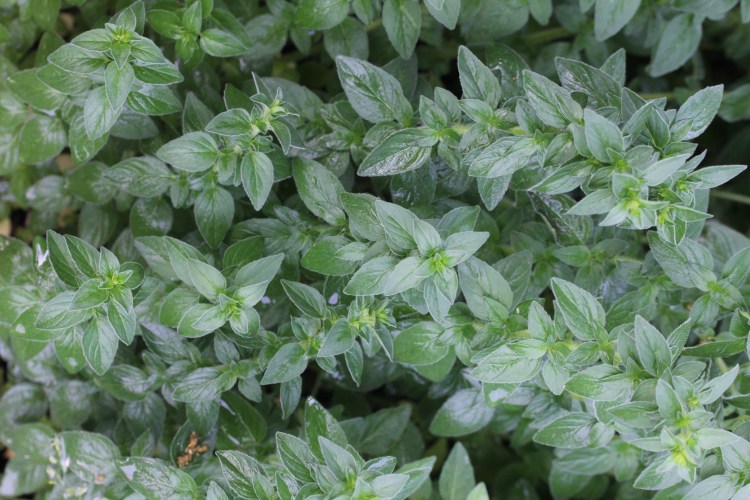
Origanum spp.

As a member of the mint family Origanum/wild marjoram has its own aromatic essential oils. It is a common perennial found all over the world. Lots of small, ovate shaped, gray/green leaves grow oppositely on a single, downy, square stem (sometimes purplish). These are dotted with very small depressions. This plant grows about 24 inches high. Numerous, tiny ,two lipped white flowers ( with pink or purple tints) grow on erect, terminal clusters. Oregano often appears to grow as a bush shaped patch. It will thrive in just about any soil, tolerates drought, and prefers full sun.

Many older classic herbals leave this herb out as it is more known for culinary use in the US. If you wish to dig deep into the medicinal uses of Oregano you might consider resources originating from Hispanic cultures and countries. Here you will see it used for “cold invasion” or a more bile/pitta constitution. Oregano is gaining more popularity in the west for its antiseptic/antiviral and vasodilating properties. Historically this plant has been used to treat childhood illnesses, headaches, the flu, fever, colds, bronchitis, and asthma. It may help with digestive issues such as colic, gas, indigestion, nausea, vomiting, poor appetite, and parasites. Some herbalists have used it for problems related to menstruation, cramps, headaches, earache, insomnia, inflammation and high cholesterol. Externally it is used as a liniment, poultice, or compress for sprains, injuries, swelling, pain, itchy skin, animal or insect bites/stings, dizziness, and bruising. When inhaled as steam it can help clear and open the lungs, relieving a bad cough. In Hispanic cultures oregano is a popular remedy for conditions of a “spiritual” nature where it might be used in a ritual spray, bath or cleansing.

Energetics:pungent, bitter, warm, dry

Element: air

Contraindications: avoid all but culinary use during pregnancy

Sleep Tea (White VERVAIN)

I am pretty much out of ideas for tinctures, salves and oils until I move some product. My apothecary cabinet is just bursting. I hate to see my plants go to waste. I set the goal of trying to harvest as much as I could from the backyard pharmacy over the this summer. That means formulating lots of bath, tea, and steam mixtures. I usually only make very small batches of these types of things for home use. Dried products often require large amounts of fresh herbs, more than my garden can produce for sale. But my crisis care packages are a spontaneous gift which I put together based on what have on hand until it is gone. Each bag contains items to support the spirit during times of grief, death, environmental disaster, chronic illness or stress.

My sleep tea contains-white vervain, mint, chamomile, rose and dandelion leaf to support relaxation, recuperation, and stress relief.

White vervain

I planted some white vervain in my garden this summer on a whim. I was not expecting to find much on it while researching for this post. I don’t know many herbalists who use it. It is not found in my oldest most used book. But it happens to be one of those ancient “heal all” plants with so many important uses.

Blue vervain is native to North America and is more commonly used as here as medicine. White vervain is a European perennial that is under a foot tall. It has smaller , opposite, palmate leaves with toothed lobes on a very still square stem. Tiny, simple, white/lilac colored stems that appear continuously starting from the bottom in June-October. These grow on long slender spikes, often widely spaced and with no scent. This plant prefers moist soil and sun.

Historically both plants has been used internally for seizures, nervous system support, mental exhaustion/mind racing, insomnia, anxiety, PMS, mood swings, constipation, digestive issues, poor absorption, colds, fever, flu, inducing a sweat (hot tea), hot flashes, congestion, asthma, pneumonia, female tonic, painful/irregular menstruation, parasites, low milk supply, mastitis, jaundice/hepatitis/liver weakness, gallstones, gout, urinary tract infections, edema, incontinence, kidney/bladder stones, headaches, lowering blood pressure, poor circulation, removing heat, chronic conditions/fatigue, thyroid issues, inflammation, lax tissues, cysts/growths, bleeding, detoxifying the lymphatic system, and restless/hyperactive/irritable children.

Externally these herbs have been used for skin conditions like rashes, poison ivy, eczema, acne, boils, burns, scratches, wounds, ear infections, rheumatism, bruises, sprains, gum disease, dry skin, hemorrhoids, nosebleeds, and neuralgia.

Latin Name: Verbena officinalis (white) or Verbena hasta (blue)

Family: Verbenaceae

Parts Used: Leaves, stalks, flowers

Energetics: bitter, acrid/pungent, cold, tissue relaxing/sedating, drying, opening.

Element: Earth

Spiritual/Emotional Uses: as an offering/blessing to nature spirits or elementals. To support peace, abundance, joy, tolerance, moderation, grounding, and balance. To banish unwanted things and emotions. As “brooms” for energetic cleansings. To clarify ones thoughts or expand perception/view. To purify spaces and objects, especially water. As a way to decrease the speed, intensity, over activity of a situation and accept things/people as they are in the present moment.

Contraindications: use during pregnancy. Large dose may cause vomiting.

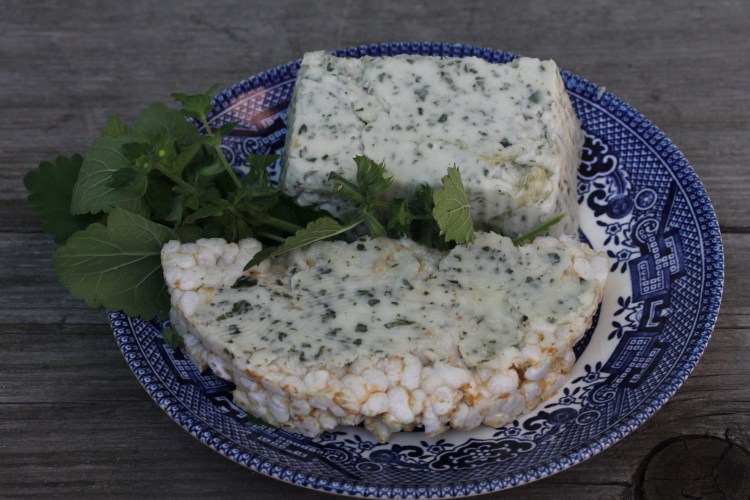
Lemon Balm Honey Butter

As herbalists we are very familiar with using the medicinal properties of herbs and fats in the forms of infused oils and salves. Plants have many fat soluble properties such as certain vitamins, pigments, steroids, alkaloids, lipids, waxes, triterpenoids, chlorophyll, saponin, carotenoids, phytoestrogens, and volatile oils just to name a few. Plants in the mint family, like lemon balm, have high levels of essential oils that infuse well in oils like coconut, olive, and butter ( also its substitutes). They also impart lovely tastes and smells to the meals we consume. The fats we use for foods can be quite cheap, easy to come by, and contain beneficial phytonutrients. Food builds community and culture which is also a type of healing. Let us not forget and also consider all the creative ways that humans have ingested the medicinal properties found in the vast botanical world. Medicine can taste good and come in lots of beautiful forms that make it more interesting and palatable. Fresh feverfew leaves are a bit bitter on their own but when made into a butter support regular consumption and the treatment of migraines. Just about any culinary herb can be made into a tasty butter. I have made one using chive blossoms that is quite pretty. Adding in honey, a plant’s colorful flowers, or using a fancy mold can enhance flavor and impress all who come to share and eat.

Instructions

Set out a stick or block of butter on the counter for 15 minutes. You don’t want it to be hard from the refrigerator or warm enough to cream for baked goods. Cut it coarsely into pieces and place into a food processor. Add 1/4-1/2 cup of fresh herbs. If making a butter that might be used on baked good you can add honey to taste. Turn on the food processor and whip the butter until it has a creamy consistency. Use a spatula to remove. You can put the finished product into a container. Better yet use a mold. The sky is the limit as to what can be used- Ice cube trays, silicone candy molds/baking cups, cookie cutters, wooden butter molds, or jello molds. My favorite ones to use are the really decorative ones commonly used to mold rice/sushi. Freeze the mold for 30 minutes before removing the butter from it. Then serve or refrigerate.

Herbed butters can be placed in the freezer for longer storage. The can be used on grains or roasted vegetables. Honey lemon balm butter is pretty decadent just smoothed on a simple piece of good homemade bread or a warm muffin.

Melissa officinalis

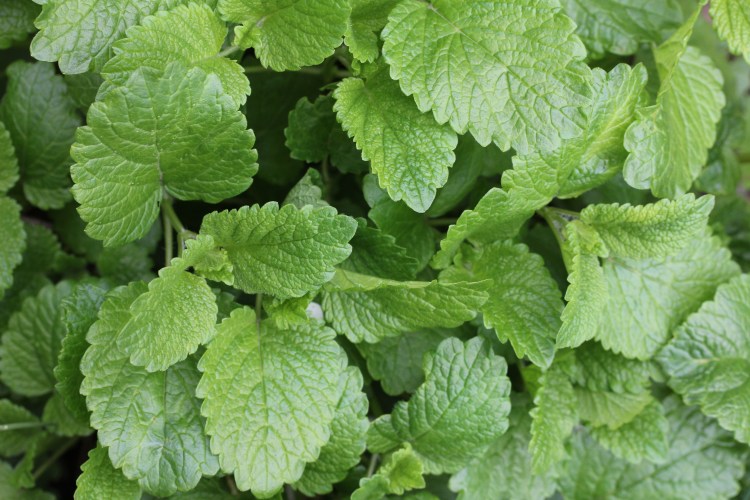
Lemon balm is a perennial found in the Mint family. Its many tall, auxiliary, four sided stems have very small two lipped flowers at their tips. A favorite of bumblebees these can be white, lavender or pink. The leaves are brilliant green, heart shaped/oval with a point. These are oppositely arranged with slightly serrated margins. Most members of the Mint family possess highly aromatic essential oils which repel pests. Mellissa has a unique smell of artificial lemon. This herb can grow as high as two feet tall. Easy to grow- it prefers moist, rich, well drained soil in shade or partial sun. Lemon balm grows well in pots and in most climates but can self seed and become an invasive plant. Remove volunteers/babies as they appear to prevent this.

Melissa is versatile and has a long history of use. It is cooling, calming, and cleansing. Its antispasmodic action makes it useful for treating menstrual cramps, general pain, headaches and infant colic. As a digestive it reduces indigestion and gas. High levels of the volatile oil cintronellal are helpful for depression, insomnia, restlessness, nightmares, teething, and anxiety. Lemon balm is a favorite tea with children due to its mild taste. Powerful antiviral and antibacterial properties make it popular to treat childhood illnesses, the flu, colds, and viruses in the herpes family. As an antihistamine it is useful for allergies and eczema.

Lemon balm can be applied externally on sunburn, wounds, burns, insect bites, and boils.

Medicinal Parts:leave and immature tops. Due to loss of volatile oils it is better to use it fresh or frozen rather than dried.

Energetics:sour, cool, dry

Element:water

Contraindications:Hypothyroidism. If you have a bee venom allergy do not use the essential oil in homemade bug repellant as bees love the smell.

Lemon balm appears in recipes to wrap fish. It can be a substitute for basil or parsley in pesto, salsa and tabouleh. Replace it for green in salad, soups, and sauces. Try it in a jelly, curd, or butter. Slip it into muffins and other baked goods.

Healing Oil (COMFREY)

When I lived in the Pacific Northwest, Comfrey was a plant to be feared. Do too much digging around it, and this plant will quickly take over a garden bed. This herb is never to be easily removed once happy and established. Comfrey is best added to a backyard pharmacy by ordering the rootstock from a supplier or getting a plant from a friend. Years back I tried planting some roots in an area I devoted to “invasive” plants. But nothing ever really does well there as it is in full shade most of the day. Most medicinal herbs prefer full sun to thrive. In the last year two people have given me two plants which I planted in a sunnier spot. Now both are lush with growth but staying controlled so far. I do not plan on disturbing those roots and I have had several harvests of leaves. Comfrey seems to like to picked often, just like my large leaf plantain and calendula. If you are familiar with Permaculture or Biodynamic gardening, you know that comfrey leaves provide valuable minerals and other beneficial things to soil when composted. I certainly plan to to do that come October. But hating to waste anything that obviously wants to be used as medicine , I had to come up with some way to use it along with other plants. Even though I have a lot of oils in the backyard pharmacy cupboard, I guess I needed one more…. . This oil will be set aside for a base in many products. It makes use of four herbs that are very well know for their skin healing properties.

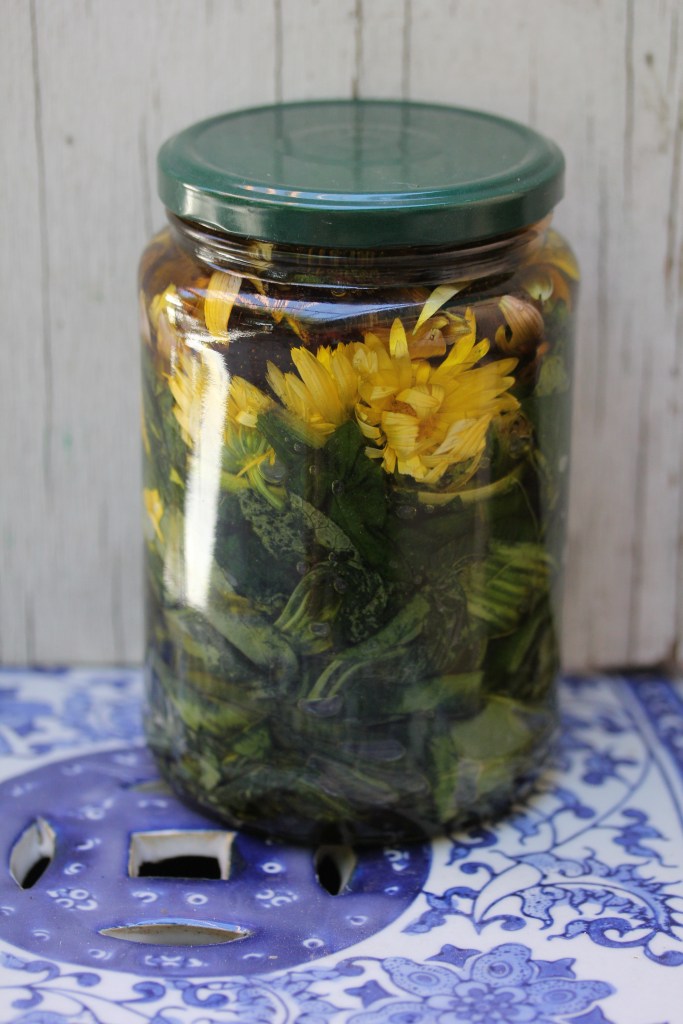
I always use a folk method for making oils. I let the plants guide me as to what is to picked and how much. For this oil I loosely packed a large jar with calendula flowers, echinacea flowers, plantain leaf, and comfrey Leaf. I prefer to use organic US grown olive oil. So far this has created oils that are stable, have a long storage life and don’t require added preservatives. Since there is a lot of fresh plant material in this product, I will only do the infusion for 2 weeks. It is warm enough in my house during the summer months that I can just let it sit on top of a cabinet. I make sure to release any air bubbles before sealing and try not to rupture cells wall by too much by applying a lot of pressure when straining.

Comfrey hybrid, possibly Russian or “rough” comfrey. Note the long ruffled leaves.

Comfrey is a common perennial found in meadows, woodlands, along streams, gardens and moist places. Long, lanceolate, alternate leaves have numerous coarse/rough hairs with smooth or ruffled margins depending on the variety. Leaves MAY BE sessile or petioled, often presenting as a close to the ground, basal rosette in the spring. Shoots of tall, flowering, hairy, 1-4 ft long stalks occur as the season progresses. Stems and leaves MAY be winged/angular/ribbed. Clusters of medium sized, white to purple, tube/bell shaped, flowers grow on the tips as droopy racemes. Roots are numerous, small to medium, and spread widely throughout the soil. When cut even a small piece can easily produce another plant. The rootstock is white on the inside, fleshy and dark on the outside. It produces a slimy, glutinous juice. Comfrey is worth having in the garden to attract bumble bees and build soil.

This is plant is well known for its ability to heal due to its ability to encourage rapid cell, connective tissue, bone, and cartilage growth growth. It breaks down red blood cells, and soothing or protecting damaged tissues. Its astringent properties can stop bleeding quickly. When fresh it has the highest mucilage content of any medicinal plant. It is a great expectorant to remove mucus and other discharges from the body.

This plant is commonly used externally for sores, wounds, hemorrhoids, varicose veins, insect bites, burns, tendon/ligament/ joint (pain, inflammation, injury,) sprains, pulled muscles, dislocations, arthritis, back pain, rheumatism , bursitis, phlebitis, mastitis, acne, eczema, carpal tunnel, surgical scars, sunburn, swelling, wrinkles, dry/rough skin, swelling, dandruff, nosebleeds, fractures and bruising.

Historically this plant has been used internally for hemorrhage/internal bleeding, ulcers/inflamed stomach lining, pleurisy, bronchitis , pneumonia, to help regulate blood sugar levels, diarrhea, poor digestion, colitis, asthma, gallstones, heartburn, and broken bones

As a mouthwash is has been used to treat hoarseness, laryngitis, tonsillitis, and bleeding gums.

Latin name: Symphytum (there are several varieties, this plant easily hybridizes so exact ID can be challenging)

Botanic family:Boraginaceae

Parts used: Leaves and roots

Energetics:bitter, sweet, cool, moist

Element:water/air

Spiritual/Emotional uses: to support clarity, connection, unity, inspiration, balance, expansion, manifestation, and pulling ideas together.

Contraindications: the roots contains alkaloids that are toxic/carcinogenic to the liver. The leaves have a lesser amount of this chemical, especially during late summer and fall. Internal use should only be undertaken under the supervision of an experienced care provider and only with the true Symphytum officinale variety. Internal use of the plant by individuals who are pregnant, elderly, or young and prolonged use is not recommended. Do not use on deep or dirty wounds and on bones that have not been set due to how fast it connects cells. Hairs on the fresh plant may irritate the skin or cause dermatitis in sensitive people when initially harvested. Be careful not to confuse it with foxglove which has similar leaves and bell shaped flowers.

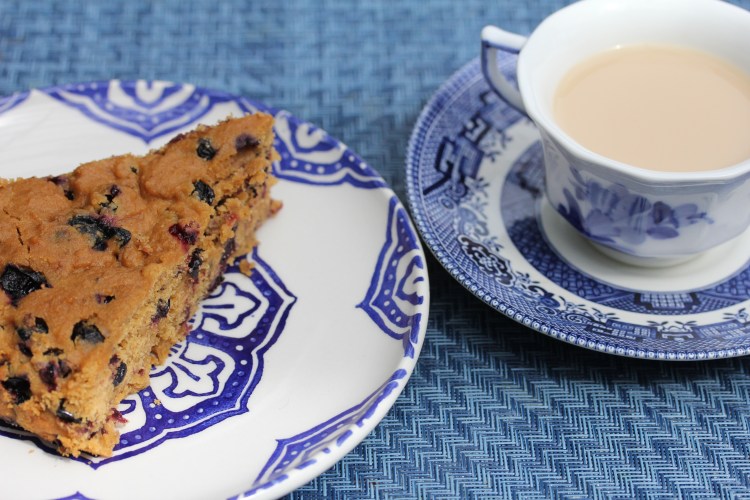
Gluten Free Black Currant Cake

I love the color and texture of this cake. I was not sure how our fresh black currants would taste in it as our berries are a bit spicy. But the sugar and almond extract provided the needed balance. There are not many recipes that I have found to use up all of our black currants. Most people are used to them dried ( as small raisins) or in jam. Black currant is my favorite tea and of course is pairs well with this dessert.

Ingredients and Instructions

Preheat oven to 350. Grease and then line a 9 inch springform pan with a circle of parchment paper. Set aside.

In a large bowl sift together

1 cup of brown rice flour

1/4 cup of finely ground almond or hazel nut flour

1/4 cup of tapioca four

1 teaspoon baking powder

Add to the bowl and mix well

1 tsp of almond extract

1/8 tsp of cardamon powder

In a small bowl use beaters to cream together

1/3 cup of your choice of butter, softened at room temperature

3/4 cup of coconut, coconut palm, sucanat, or brown sugar

After 4 minutes add in

2 large eggs

Mix your small bowl into the large bowl

Lightly fold in

2 cups of black currants , sorted and cleaned

Pour mixture into pan, level by tapping on counter and place into oven

Bake for 40 minutes or until a skewer inserted comes out clean. Let cool for 10 minutes, then move to a wire rack to fully cool. Serve with whipped cream.

Ribes nigrum

Currants are one of my favorite medicinal plants. I am a big fan of red currant jam and traditional English “black currant tea”. The fruit is high in the vitamins and anti-oxidants that our circulatory system loves. The berries have 4 times the amount of Vitamin C as oranges and 2 times more anti-aging properties than blueberries. The leaves are a strong astringent for use in external skin care. The variety I grow has a spicy taste similar to juniper berries, so it works better in savory dishes or simple syrups rather than dried, jam or in a dessert. Black currants are the main ingredient in creme de cassis.

You will find black currants as a rare cultivar in a few states in America. Importation of plants has been banned and growing illegal in the US as the plant can carry a fungus known to kill pine trees. The plant grows as a wide, untidy bush of long shoots, 4-6 feet high. The leaves are textured, alternate on the shoots, palmate, with 3-5 lobes and double serrate. Drooping racemes of yellow or white flowers appear in mid spring, a favorite of bumble bees. The berries are almost black, ripe when large, almost bursting their skins, and no longer hard. I know to pick mine when they start falling onto the ground or disappear when the animals start to eat them.

An infusion of black currant leaves stimulates the kidneys and historically has been used to treat gout, inflammation, liver issues and heart disease. The berries in can be used to treat kidney disease, high blood pressure, colic, glaucoma, eye strain, and rheumatism. The fruit and leaves can be consumed as tea or juice for bad coughs, sore throat, gum disease, and laryngitis. If you have diarrhea or organs that need toning a tea of black currant leaves might prove useful. The essential fatty acids in the oil from the seeds is thought to(internal use) prevent and repair damage to joints or (external use) relieve eczema and psoriasis.

Contraindications:clotting/bleeding disorders, surgery.