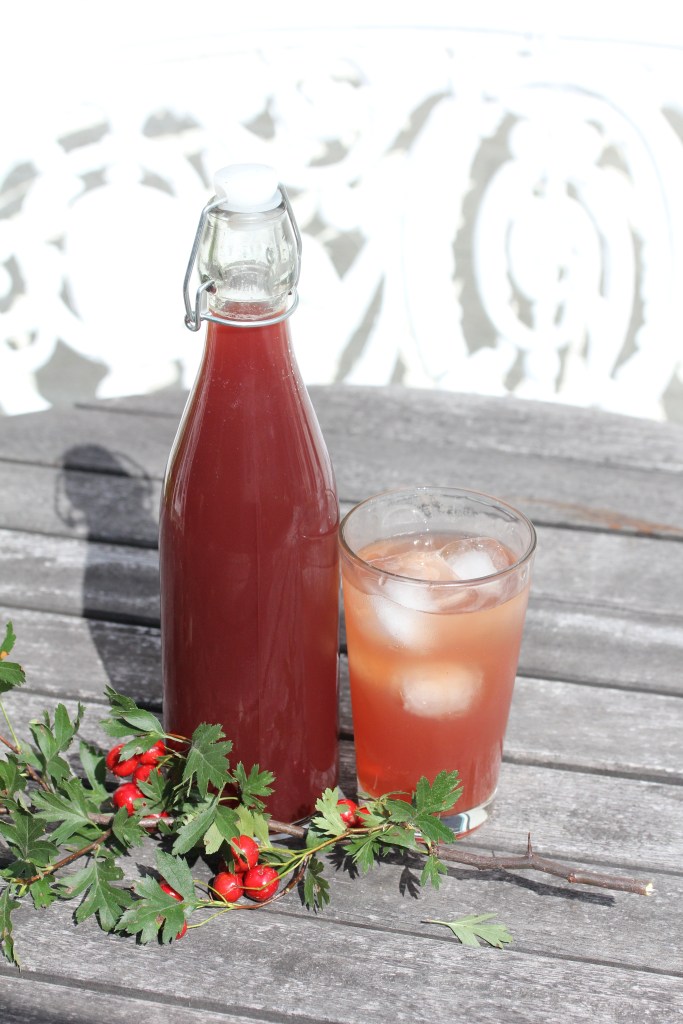
This one has been on my list to make for awhile. Thanks to the squirrels I only had about 2 cups of red ripe hawthorn berries to harvest. Last summer they got to every single one while we were on vacation. I have been looking for ways to support my heart’s health as I age. Earlier this summer I harvested a lot of hawthorn flowers and leaves to dry. These make a lovely infusion when berries are scarce. I am mindful of the type of herb and its action when planning to take it as medicine- daily, for years. Herbs that are astringent may dry out “the kidneys” with long term regular use. There might be other constituents in a plant that cause irritation when used for lengthy periods. It is good to have several options that can be rotated. Leaves and flowers might have a milder action than berries, bark or roots. This syrup will go fast or will have a limited shelf life in the refrigerator. If you have the luxury of making a lot, it can be frozen in ice cube trays or in a wide mouth jar. Dried berries won’t have the same strength as fresh, but can be substituted. I feel blessed to have a hawthorn tree on my property. It is the only “medicinal tree that I been able to establish so far.
Happy Heart Syrup
In a large stock pot add ……
2 quart of filtered water
Bring to a roaring boil and add….
2 cups of fresh ripe hawthorn berries
1/2 cup of dried rose petals
1/2 cup of dried hibiscus flowers
Reduce heat to low and simmer for 30 minutes.
Measure out 2 cups of infusion in a bowl. Add….
2 cups of honey
Stir well and let cool.
Must be refrigerated or frozen for storage. The syrup should be good until it molds or ferments, which may never happen.
Hawthorn is a small tree/shrub (6-20 feet high) that one does not see often where I live. It must be cultivated and cared for to be attractive in an urban setting. The bark is ash colored and the wood quite hard. The leaves are small, shiny, dark green (on top) and have irregularly toothed lobes. Those grow on multiple branches (shooting in all angles) which have small but not terribly sharp thorns. It produces clusters of beautiful, tiny, showy, white flowers (5 petals) in the spring and bright red berries in late summer. The fruit is a favorite with wildlife. If your harvest is not timed right, the perfectly ripe berries can disappear off the tree over night. Ripe berries will be a darker shade of red ,close to that of a bing cherry.
Hawthorn likes to grow along streams and in meadows. You will often find it on older properties like farms, especially as a hedge. It will grow well in most climates.
Crataegus is best known for its effect on the heart. It normalizes blood pressure by regulating heart action/contraction. It strengthens the heart muscle/connective tissues and dilates blood vessels. Hawthorn can be used for either high or low blood pressure. Historically the berries have been used to treat myocarditis, arteriosclerosis, angina, congestive heart failure, heart palpitations, irregular heartbeat, blood clots, high cholesterol, variscose veins, and Reynaud’s syndrome/poor circulation . A tea of the flowers or leaves may be helpful for stress, mild, pain/spasms, headache, diarrhea, indigestion, gout, altitude sickness, arthritis, joint injuries/slipped discs, tendonitis, hernias, and insomnia.
Parts Used: ripe berries, leaves, flowers
Latin Binomial Name: Crataegus oxycanthae
Energetics: Sour, sweet, bitter, dry, warm
Emotional/Spiritual Uses: Supports confidence in our achievements and rising above our limitations. Possible reward or victory after hard work, time, and energy expended. Evaluating if the effort was worth it or truly for the good of all. Calm, ease, satisfaction and peace after a period of struggle and conflict. Fosters leadership and teamwork. Receiving guidance and assurance about an important decision.
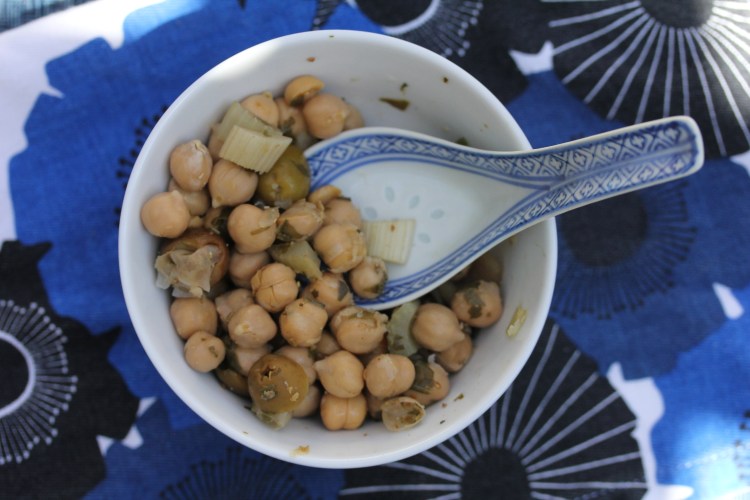
This is a great summer condiment. You could mix it with mayonnaise for a sandwich. It can be an ingredient in all kinds of salads. As a pickle it serves to accompany any meal as a side dish. It transports well for a picnic. I like having refrigerator pickles as an option when I need flexibility or options for throwing together last minute dinners on very hot days. It can be a struggle to cook in a warm kitchen when you are tired or unprepared. Refrigerator pickles allow me to have small amounts of several different types for quick, creative experimentation. Homemade batches allow me to serve multiple appetizers on a large platter that reflect different tastes (sweet, sour, salty, hot), textures (crunchy, crisp, soft, firm) or ethnic cuisines. Fruits, vegetables, and legumes can all be pickled to be sweet or savory. Pickles can also be used as flavorings in a dish as you would a spice or culinary herb.
Pickled Chickpeas
1 TBSp of finely diced jalepeno
Juice and zest of one small lemon
2 TBSP finely diced red or yellow onion
1/4 cup finely diced celery or purslane
1/2 tsp of powdered coriander
1/2 tsp of powdered cumin
1/2 tsp of powdered fenugreek
2 TBSP of finely diced fresh oregano
1/2 tsp of smoked salt
2 cups garbanzo beans
1/2 can of green olives sliced
Place all ingredients in a very clean pint canning jar.
Boil 1 cup of apple cider or seasoned rice wine vinegar. You can also add a bit of sugar if you enjoy a sweeter pickle. Let cool a few minutes and then poor into the jar. If you have space in your jar you can top it with boiled tap water. Let cool further and seal. Let sit overnight before using. Store in refrigerator for up to 3 months.
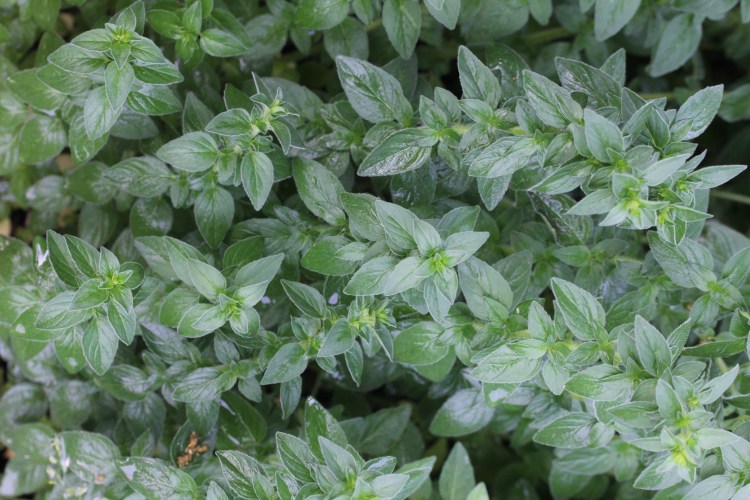
As a member of the mint family oregano/wild marjoram has its own aromatic essential oils. It is a common perennial found all over the world. Lots of small, ovate shaped, gray/green leaves grow oppositely on a single, downy, square stem (sometimes purplish). These are dotted with very small depressions. This plant grows about 24 inches high. Numerous, tiny ,two lipped white flowers ( with pink or purple tints) grow on erect, terminal clusters. Oregano often appears to grow as a bush shaped patch. It will thrive in just about any soil, tolerates drought, and prefers full sun.
Many older classic herbals leave this herb out as it is more known for culinary use in the US. If you wish to dig deep into the medicinal uses of Oregano you might consider resources originating from Hispanic cultures and countries. Here you will see it used for “cold invasion” or a more bile/pitta constitution. Oregano is gaining more popularity in the west for its antiseptic/antiviral and vasodilating properties. Historically this plant has been used to treat childhood illnesses, headaches, the flu, fever, colds, bronchitis, and asthma. It may help with digestive issues such as colic, gas, indigestion, nausea, vomiting, poor appetite, and parasites. Some herbalists have used it for problems related to menstruation, cramps, headaches, earache, insomnia, inflammation and high cholesterol. Externally it is used as a liniment, poultice, or compress for sprains, injuries, swelling, pain, itchy skin, animal or insect bites/stings, dizziness, and bruising. When inhaled as steam it can help clear and open the lungs, relieving a bad cough. In Hispanic cultures oregano is a popular remedy for conditions of a “spiritual” nature where it might be used in a ritual spray, bath or cleansing.
Latin Name: Origanum vulgare
Botanic Family: Lamiaceae/Mint
Parts Used: leaves
Energetics:pungent, bitter, warm, dry
Element: air
Contraindications: avoid all but culinary use during pregnancy
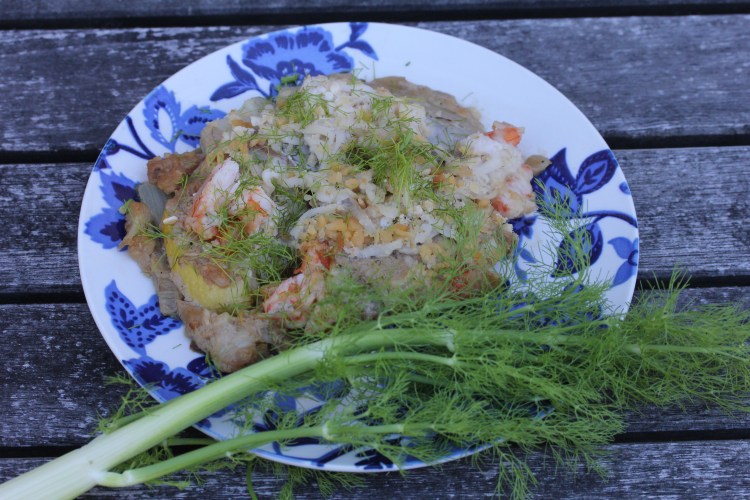
This recipe is perfect for an all in one dish that travels well for a potluck, picnic or lunch of leftovers. It is quick to assemble and put in the oven. Allowing you time to do other busy chores or relax before dinner. I love any creative way to use up some of the summer squash growing like crazy in my garden.
Shrimp and Fennel Gratin with Vegetables
Preheat your oven to 350
In a large rectangular pyrex baking pan layer your ingredients in the following order….
1/4 cup of cream (or vegan substitute). Spread to create an even coat on the bottom of the pan. You can also just use milk.
1/2 a medium onion coarsely chopped and sauteed in 1 TBSP of olive oil.
1 medium fennel bulb sliced in thin cross sections (from stalks to bulb), seared in 1 TBSP of olive oil.
1 large peeled potato cut in thin cross sections. You could also use sun chokes or other root vegetables.
1 medium scallop summer squash cut in cross sections.
1/4 cup of cream (again)
1/2 cup of cauliflower cut in small pieces.
salt and pepper to taste
1 cup of mild white cheese ( I used vegan moz)
3/4 cup of yogurt spread in a even coat.
20 medium cooked shrimp coarsely chopped
bread crumbs
Bake for 1 hour
Let cool for 5-10 minutes and serve.
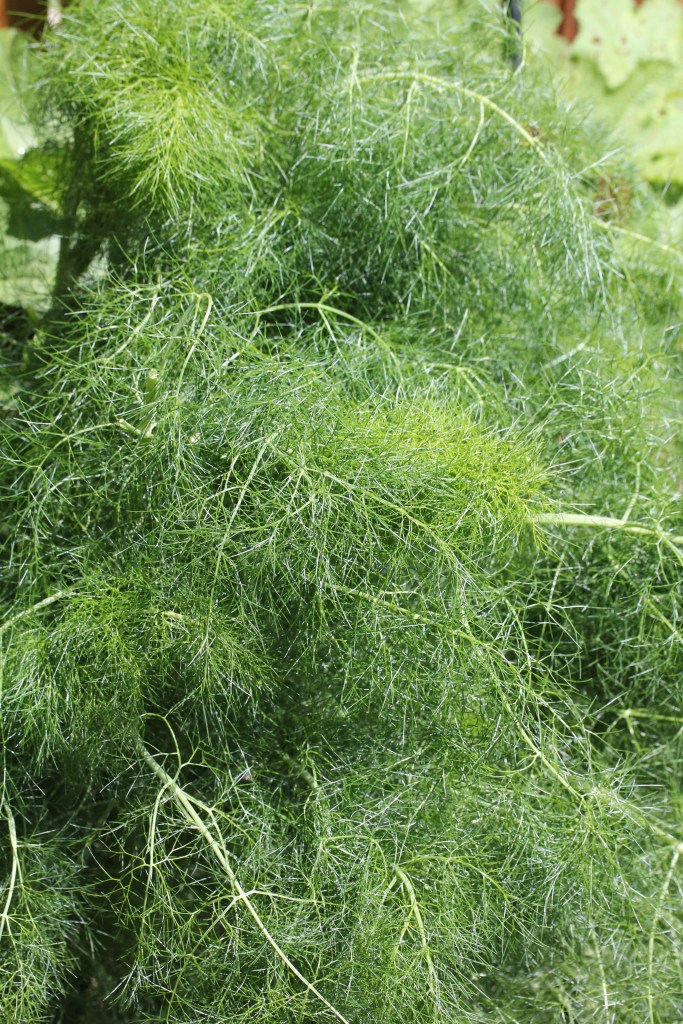
Foeniculum (fennel) is a member of the parsley/carrot family that is often found in colonies. It is important to identify this herb accurately, even if growing in an urban yard or garden. Warmer climates produce a perennial almost 5 feet tall. A carrot shaped root is below the ground. When very mature the stem can form a large white “bulb” (like celery) at its base. There are 2-5 hollow, pithy, finely grooved bright/jade green stalks with bluish stripes. Some plants appear to have a waxy/white “bloom”. The leaves grow from the center/basal (immature) or branch off upper stalks as wide alternate sheaths (mature) that wrap around the outside. Leaf shape is pinnate, very compound, and constructed of numerous threadlike filiform segments (like some ferns or asparagus). Compound umbels produce yellow flowers in late summer or early fall. When cut, torn, or rubbed the plant parts produce a strong licorice scent. Fennel seeds are light green (becoming a bit yellow as they dry/mature) oblong, dense and a good size.
Caution: Poison hemlock and fennel are easy to confuse. Hemlock will have purple blotches/spots on the stalks, leaves that lacy/broader/more triangular, white flowers, and an unpleasant scent. Poison hemlock and young dying fennel in the fall can be especially hard to tell apart. When in doubt crush plant material or seeds with the foot and smell without touching the plant.
Foeniculum is well know as a remedy for stomach and intestinal complaints. It has been used to treat abdominal cramps, bloating, indigestion, nausea, constipation, heartburn, bad breath, gas, and colic. It expels mucus, relaxes bronchi and clears congestion in the lungs. It relieves a horse throat, moves stagnation in the liver, and increases the flow of breast milk. This herb may help stabilize blood sugar levels, Chewing dried fennel seeds stimulates the digestive juices, helps digest fats, assists in the assimilation of food and treats bad breath. As an infusion it serves as a diuretic for kidney stones and gout. As a weak tea it can lower fever, reduce teething pain, and stop hiccups in children.
Parts Used: Leaves and seeds
Energetics: sweet, warm, moist
Element: fire
Spiritual and Emotional Uses: To move stagnant energy and bring sweetness and freshness back into life. To restore trust, security and purity to a relationship. To repel negative energies.
Contraindications: Avoid therapeutic doses in pregnancy. Excess consumption can stimulate the nervous system.
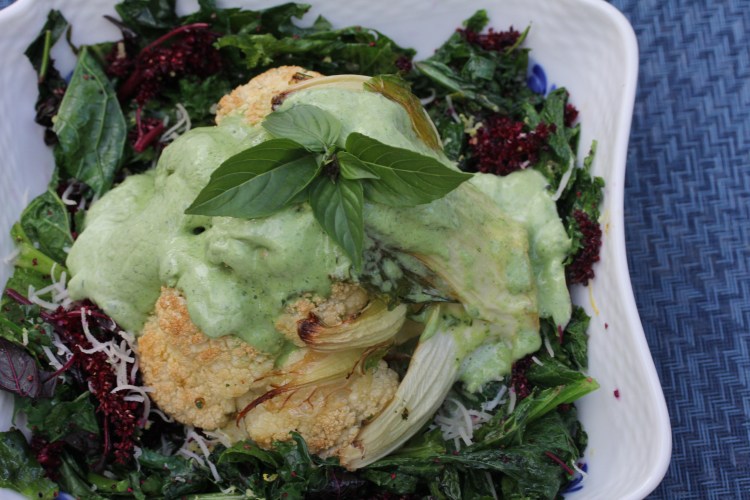
This is a flavorful, filling meal if you need a vegetarian option. I love being able to go out into my garden and gather an abundance of ingredients. It looks very attractive and impressive if your are doing a formal dinner or elegant brunch. The sauce is amazing. Be sure to make extra if you want a quick way to dress up pasta, grains, or other vegetables.
Roasted Cauliflower with Greens and Basil Crema
In a large attractive dish assemble the following…..
2 heaping cups of fresh picked garden greens braised in 1 TBSP of olive oil. Options include fava bean leaves, purslane, lambs quarters, mustard, kale/brassica, chard, chicory, or amaranth.
1 TBSP of grated parmesan cheese
1 TBSP of lemon zest
1/2 a large cauliflower roasted in its entirety in a large baking pan. Basted with 1-2 TBP of olive oil, salt and pepper to taste. Oven temperature at 400 until it can be pierced with a fork, about 30 minutes.
Let cool for 10 minutes and top with the sauce
Crema
1 cup of fresh basil leaves
1/2 cup of cream or vegan substitute
salt to taste
lemon juice
Place the sauce ingredients in a blender or processor. Blend until smooth and creamy.
Garnish with fresh basil leaves or summer squash blossoms
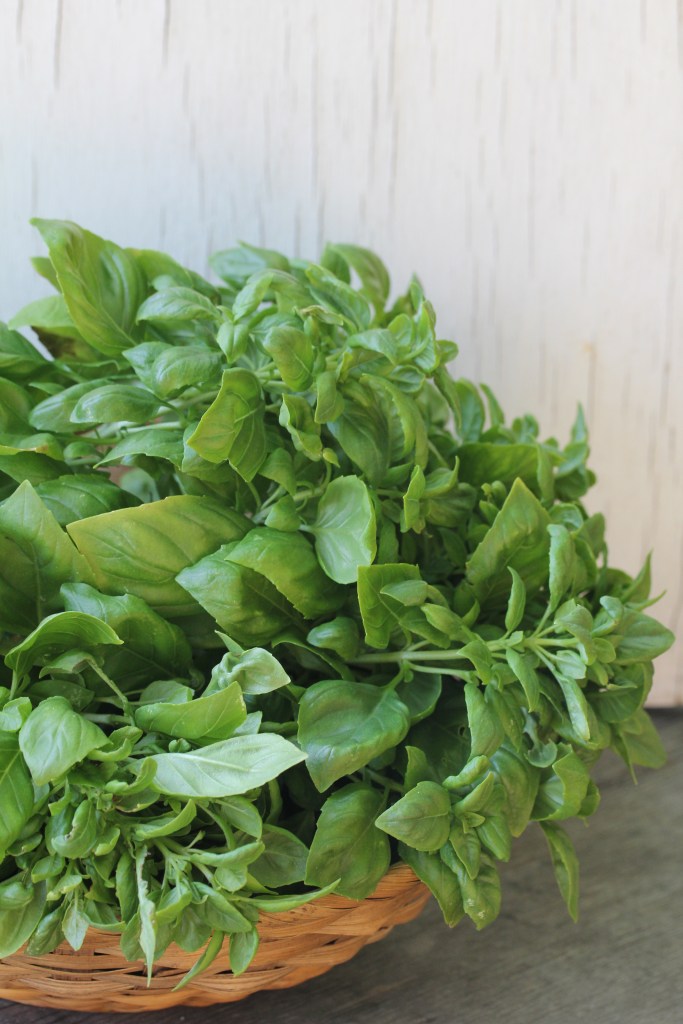
Basil is in the mint family. Typically it is an annual but will overwinter indoors. It is a very common garden herb used as a companion plant and insect repellant. A thin branching root produces several lush square stems growing 1-2 feet high. The leaves can vary from bright to dark green depending on the variety. Some types like Thai basil have purple in their oppositely arranged leaves. Leaves can be oval to spade shaped, toothed or smooth in their margins. Like others in the family, it has lots of small two lipped flowers that grow on racemes/spikes of 2-4 inches. These are a favorite of bumble bees and come in shades of white, red or purple. A distinguishing feature of Ocimum is the smell, similar in all varieties but with slightly different “notes”.
This plant warms, calms, and clears phlegm/damp. Historically basil has been used to treat all manner of digestive complaints such as cramps, vomiting, constipation, gas, low appetite, diarrhea, bacterial infections and inflammation. It stimulates the flow of breast milk, cures a headache, and calms a bad cough. Ocimum has been used for depression, the flu, fever, asthma, retained placenta, fever, anxiety, bronchitis, and fatigue. It works well to support the lungs.
Externally it has helped with acne, bug bites, fungal infections, sore muscles, and arthritis. The essential oils/scent make it useful in aromatherapy, ritual bathing/cleansing, beauty products and as incense.
Latin name: Ocimum basilicum
Parts Used: Leaves and flowers
Energetics:bitter, warm, dry, pungent
Element:Fire
Spiritual/Emotional Uses: Integration, especially when two things seem contrary in nature. May be used to bring luck protection, or blessings to body, home or new relationships. Use it when there is conflict or negative energies in a situation. It is commonly used in ritual baths , especially for the dead.
Contraindications: Avoid large/therapeutic doses in pregnancy
Plant Spirit Medicine or a Plant Journey is any experience where there is a connection and a meaningful exchange that takes place in non ordinary reality. The giving can take the form of healing, knowledge, spiritual growth, or acquiring a teacher/guide. These “journeys” can be facilitated, planned, structured or take place in a group. The plant offers its medicine to us in a form that is not limited to chemical constituents, physiological effects, or its history of medicinal use.
Plant Spirit Medicine often involves the consumption of toxic plants. Botanicals known to create intense reactions in the form of poisoning, purging, hallucinations and changes in brain chemistry/neural pathways. This breaks down the barriers we have to entering an altered state. We can let go of or expand our understanding of reality.
There are a lots of modern trends around the consumption of certain plants for both healing and spiritual use. Not only do we see cultural appropriation but also over harvesting/unsustainable practices and careless use. This jeopardizes the sacred agreement between plant and human. The “medicine” becomes nothing more than an interesting experience or a very unpleasant event with unpleasant side effects that resemble poisoning.
If a plant is misused/or improperly handled it bites back. There are certain plants I know better than to use or harvest. I know I lack of a connection or karma with them.
Plant spirit medicine
Is a way to create a contract with a plant
Allows us to receive healing from a plant when it can’t be physically present.
Sometimes happens spontaneously when we are alone and least expect it. Ensuring an authentic unappropriated experience.
Can take many different forms-dreams, a symbolic encounter/sign, ritual, art, meditation, journaling etc. These may not be as intense as experiencing the symptoms associated with internally consuming a toxic plant. It does not mean these other “journeys” can be as healing or powerful.
Can be consumed internally or externally.
Plant toxicity
As herbalist we are all familiar with the term “contraindications”. Conditions related to age, pregnancy, health issues, medications, and allergies that require restriction or more careful use of herbal medicine. Most of us know that skin contact with certain plants can cause a rash in sensitive individuals due to an allergy or exposure to sun shortly afterwards. After my own interesting reaction to a plant I got curious and started to do research. I realized that there was so much more to toxic skin reactions. It just was not being discussed or thought about by herbalists. Here is what I found out.
Fresh plants that herbalists should be aware of when harvesting, touching, or processing
Types of toxic and irritant skin reactions to plants-a plants defense mechanism.
Chemical: Saps, resins, oils, etc. directly contacting the skin. Examples- poison ivy, hogweed, poison oak, poison sumac, belladona/nightshade.
Contact urticaria: Irritating hairs that can inject a chemical or cause physical irritation. Examples-bamboo, nettles, hops.
Phytophotodermatitis: Contact with a plant and then exposer to the sun shortly afterwards. Examples-rue, St. John’s wort, parsley family, citrus family.
Mechanical/irritant through thorns, sharp edged leaves or spines/glochids, fine hairs. Examples-cacti family, holly, blackberries, roses, oregon grape, borage.
Mechanical through rough surface on stems. Examples-hops, echinacea, motherwort.
Allergenic as the body’s immune system overreacts to a substance produced by the plant. Examples-asters/daisy/ragweed family
Plants can induce allergic or irritating reactions by breathing in their oils, pollen or dust. External contact can also occur through the eyes or through the use of enemas, douches, poultices, compresses, liniments , salves, baths, washes and boluses.
Treatmentfor reactions
Wash with mild soap and water
Remove fine hairs or spines with duct tape. Tweezers are good for larger thorns
Use antibiotic cream if infection developes
Ice, cold compresses, oatmeal baths
Over the counter lotions or ointments to treat itching, redness, welts, dermatitis, and hives
See a doctor if there is an increase in redness, warmth, pus, oozing of blisters. Symptoms that include heart racing, vomiting, difficulty breathing, dramatic swelling, dizziness, etc. indicate a serious anaphylactic reaction. Immediate medical care may be required if this is the case.
Minimizing the chance of an allergic reaction
As an herbalist wear a mask and goggles when processing dried or fresh plants that can release a fine dust or essential oils (plants in the mint family). This protects your lungs over time and safeguards your eyes. Wash your hands after handling plants to avoid spreading irritating chemicals to eyes, lips, or other sensitive skin tissues. Wear gloves and shirts with long sleeves when handling plants known to induce toxic skin reactions or which have botanical parts like fine hairs and thorns. For clients or family members you can do a small patch test on the skin (forearm) if you suspect the person might be allergic to an herb before applying a larger amount or to an area where the tissues are very thin.
Nettle, a plant we are all very familiar with.
If you have ever harvested nettles, you have experienced urtication at least one time. That sudden painful sensation, rash, and unpleasant tingling/numb sensation that lasts for hours or even days.
There is an ancient tradition of using urtication as a healing treatment . The intensional flogging/skin exposure to fresh nettles has been used to provoke inflammatory response. Scientific studies have found this helpful in autoimmune conditions such allergies and osteoarthritis or rheumatoid arthritis. Urticating hairs in plants have sharp, pointed, hollow bristles attached to a gland which secretes an acrid chemical. These points break off in the skin and the fluid is pressed into it.
Nettle contains several chemicals including histamine, acetylcholine, and serotonin. Its tiny hairs stimulate urtication and C fiber discharge. The stems of older plants are also slightly abrasive.
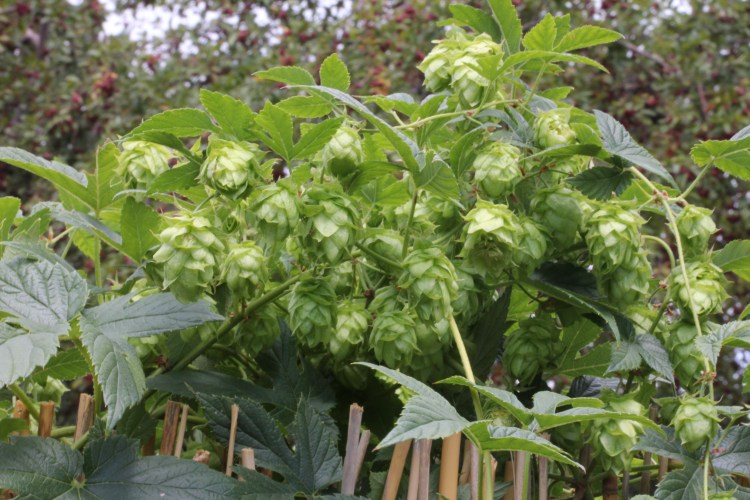
My hops plant this year was gorgeous. So much lush foliage due to weeks of unusual rain. Its growth pattern suggested something feral and masculine. I nicknamed it Green Man, sometimes imagining a grinning face under all those leaves. I enjoyed a fantastic harvest of fresh brilliant green hops last summer and was looking forward to all the things I would do with the cones to come. I left the US for a trip abroad and came home to a shock. The hops was covered in thousands of tiny white aphids and lots of invasive lady beetles. Its leaves were brown and falling off in piles. I decided to let the adults and their larvae do the job. I waiting for signs of recovery and for the population of aphids to drop. My hops only looked worse and I worried about the future impact of that non native species in the garden next summer and in my house come winter. My quick solution, cut down all the hops and put it in the garbage bin as soon as possible. It was done in a few minutes. I went on with my plans for the day, an uneventful afternoon hike with a friend. That evening my arms were covered in dozens of welts the size and shape of those hops vines. They were hot, bright red and covered in a fine rash as well. At least it did not hurt or itch.
Hops contains lupulin, a yellow powdery secretion (pollen) of the glandular hairs on the scales of the hop cones. It also contains myrcene, humulone and lupulone as volatile oils. Studies conducted on hospitalized hop’s pickers found “hop rash”, “hop eye”, and “hop gout”. The rash was believed to arise from scratches on the skin and the inoculation of proteins found in juices and pollen. There was dermatitis and welts due to abrasions from rough surfaces on the vines. There are accounts of beer drinkers also having allergic reactions to the consumption of the beverage.
As my symptoms resolved over the next 24 hours. I pondered their cause. I did not react when I harvested the hops cones last year or drank it fresh as a tea on many occasions. My allergy to bees took took two seasons and many stings to occur. Maybe my allergy was delayed and needed multiple exposures.
Or was there a lesson from the plant that I was missing? In my haste to cut down the plant I did not consult or ask permission. I was not being mindful of what I was doing. I did not treat the hops as a sentient being. I did not give it due honor or well deserved respect. I violated our contract. I did not follow the terms agreed upon.
The strong message of hops (Humulus lupulus ) was a reminder of the power of Wolf (Canis lupus). Hops is a hungry, voracious and all consuming plant as it grows. Maybe not not so considerate of its neighbors but focused only on its own survival. My cutting it down felt violent. The plant at that moment was unwanted. I did not appreciate the important role it was playing in my garden or life. I took its gifts/life force without any thought of return. It lashed back at me in the from of “heat”. I am often a bit too like Wolf in my response to things that trigger me.
The reminder on how to relate in a positive and conscious way to other people and my surroundings was the medicine that hops gave to me that day. It is hard to say if any of those chemicals absorbed into my skin stimulated a physical healing process. One I was unaware that I needed and the plant decided it needed to gift me. I did not ask for hop’s wisdom or healing but yet it knew what was best for me in that moment. This is something that has to be experienced. It can’t be learned from a book or class. Plant Spirit Medicine is ancient and powerful. It is not easily forgotten and can be life changing. It can rip our world view wide open and take us on a journey we never expected.
If you wish to explore Plant Spirit Medicine I suggest that your find an experienced guide. It has a history of cultural appropriation and risk. It would not be appropriate for me to go into greater detail on how to truly do it. I can say that it is important to write your experience down. Details of everything you saw, heard, and felt. In order to find “the meaning” you can research books on symbols, mythology, folk tales, dreams, flower remedies, the collective unconscious, spirituality etc. You can also get insight from a materia medica or and studies you have done on herbs.
I would love to hear your plant medicine stories or about any personal experiences you have had with the “toxins” in plants.

 Blackbird's Backyard Pharmacy