Detox Salve( RUE )

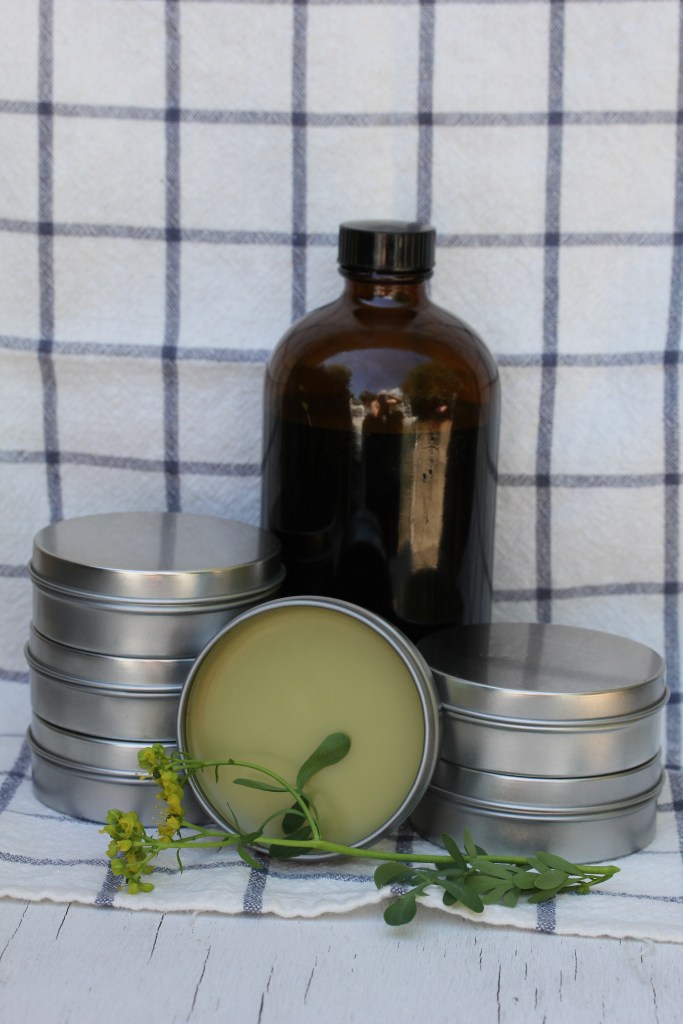
This creation of this salve was inspired by the year I studied the traditional medicine of New Mexico. In the American Southwest rue, lemon, and oregano are common medicinal herbs found in all kitchen gardens or spice cabinets. Most Hispanic families have an assigned elder that everyone goes to when there is illness, accident, or a traumatic event. In this system of healing well-being has a physical, emotional, spiritual, and community component. Community is not just limited to humans but also includes any sentient beings, ancestors and the land. When ethics, values, agreements, rules, and practices are not followed-rupture within the worldview occurs. Things become disconnected, lost and unbalanced. This causes disease to manifest so that we pay attention and make positive changes. Herbal medicine is part of a protocol of repair and renewal.

Rue is well know for clearing negative energies and trauma. In Hispanic cultures it is a common ingredient in spiritual cleansings. This plant is often used in treatments when there is “soul loss” or PTSD. It can be used externally as a spray, liniment, wash, or bath. It can be used internally as flower essence. I personally feel that it is too strong to be consumed in a tea or tincture. Rue is a powerful plant spirit that should be used with caution or experience in some cases. Many herbalist do not work with rue as people can be very sensitive to the plant’s qualities. Uses may be considered few and very specialized.

This is one of those “mother”plants in an herbalist’s garden. It may not grow for you. When it does it will be the largest, lushest, and oldest herb in your yard. Treat it with respect. Unexpectedly it may die or not come back after that last frost. After having a relationship with this one plant for many years, Rue decides her contract is done. She moves on. You have to start over and find another one to cultivate.

I like this salve for moving out of toxins and stagnation. When a serious accident or injury occurs it can be applied it to unbroken skin where there are bruises, swelling or pain. Massage it in lightly for torn tissues, ligaments and tendons or deeper for sore muscles.

For a salve, I start by making an infused oil. Fill a pint canning jar with equal parts of fresh rue and oregano. The qualities of both plants are very different and stronger when they are just picked from the garden. Rue, lemon, and oregano have very powerful essential oils that can deteriorate quickly if not preserved or stored properly. Next I add about 2 TBSP of fresh lemon peel. Then I fill the jar to the top with organic, pure Californian , olive oil. I let it set no more that 2 weeks before straining and bottling. Store in an amber bottle in a cool, dark, place. You can use any standard salve recipe with this oil or save it for other uses.
Latin name: Ruta graveoens

Spanish name: ruta/ruda

Botanical Family: Rutaceae (citrus/orange)

Parts used: aerial parts (leaves and flowers)

Energetics: bitter, pungent, warm, dry

Element: fire

Spiritual and Emotional Uses: For purification and protection. To support balance and boundaries when there is a toxic relationship. “Soul retrieval”. When ones emotional state includes self destructive behaviors.

Contraindications: allergic reaction/rash/skin and photo sensitivity to the freshly picked plant due to its volatile oils. Do not take during pregnancy or nursing. Not appropriate for thosetaking blood thinning medications or with liver disease. Internal overdose can cause vomiting/poisoning.

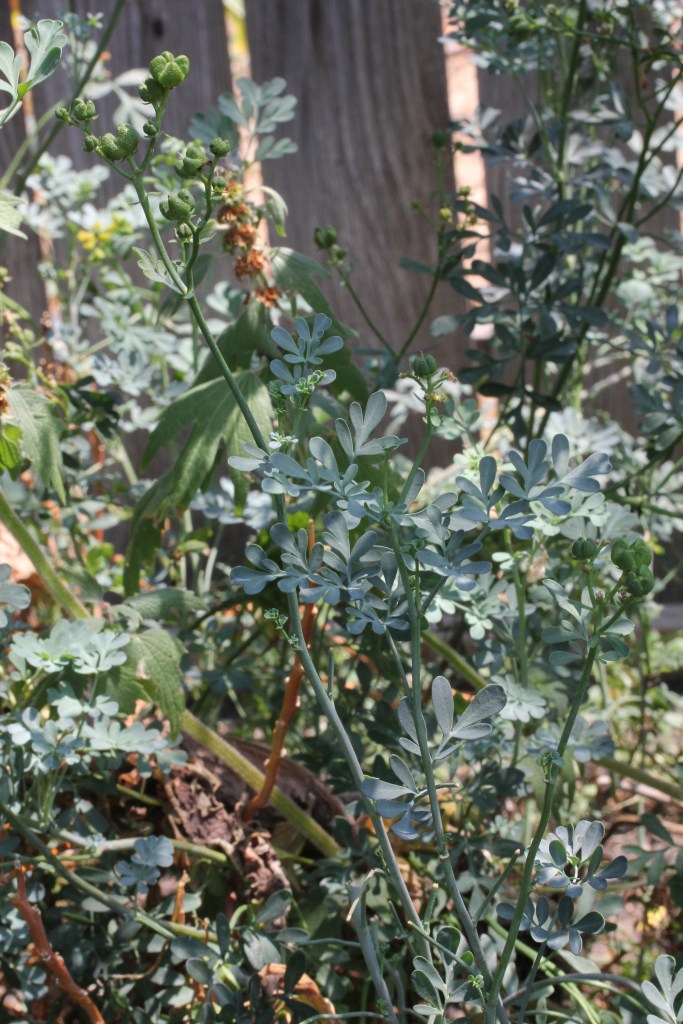
Rue is a small, aromatic, evergreen, perennial shrub with branched, glabrous “stems”. It will overwinter in cold climates but may fade in color, go dormant and loose leaves. It grows about 24 inches in height. Its blue green leaves are compound/pinnate, alternate, with spatulate leaflets. This plant has paniculate clusters of tiny yellow flowers with five petals. Rue prefers full sun and dry soil.

Historically rue has been used as a poultice, oil or salve to treat-neuralgia, poor circulation, rheumatism, tight muscles, earache, headache, eyestrain, sprains, sciatica, chilblains, sunburn, insect bites, nosebleed, spider and varicose veins. Internally it has been used to treat colic, bronchitis, colds, flu, fever, stomach disorders, indigestion, gas, gout, tinnitus, dizziness, menstrual cramps, blood stagnation in the uterus and other organs, nervous spasms, heart palpitations, hot flashes, seizures, Bell’s Palsy, paralysis, inflammation, and parasites.
NASTURTIUM and Pink Peppercorn Vinegar

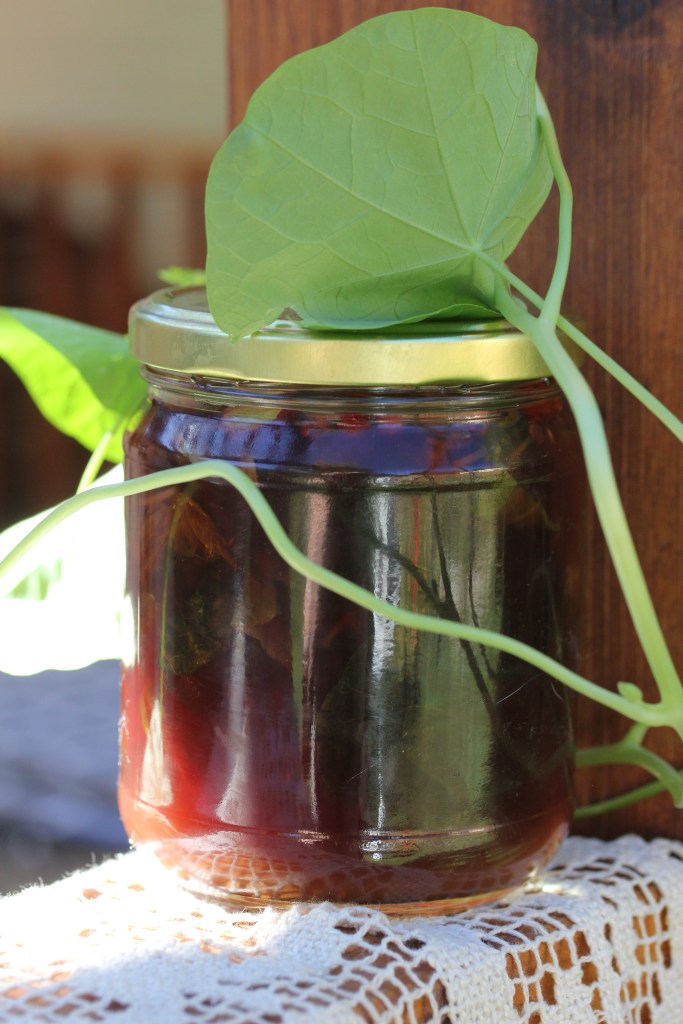
This was another early fall project. Nasturtium is very frost sensitive. I have come across all kinds of recipes that use this plant. I love the flowers in my peach salad. The leaves can be used to make “cabbage rolls” and pesto. This vinegar might appear to be culinary but it is actually meant to be more medicinal, even if you add it to some quality olive oil to make a dressing. I love the ruby red color. I added some pink peppercorns to bring out the “spicy” taste of the leaves even more. Some medicine is allowed to taste good.

Nasturtium vinegar recipe

Pack a pint jar full of nasturtium leaves and flowers. If your plant is an infrequent bloomer you can add the blossoms as they appear until you have a decent amount. Add 1 tsp of whole pink peppercorns. Fill jar with apple cider vinegar. Make sure all plant parts are covered. If you are using a metal lid, place some plastic wrap between it and the liquid to avoid rusting/chemical reaction. Let sit 4 weeks. Strain and bottle. Store in a cool, dark place. The vinegar can be used in sauces and marinades. The fruit when still green/unripe make excellent pickled capers.

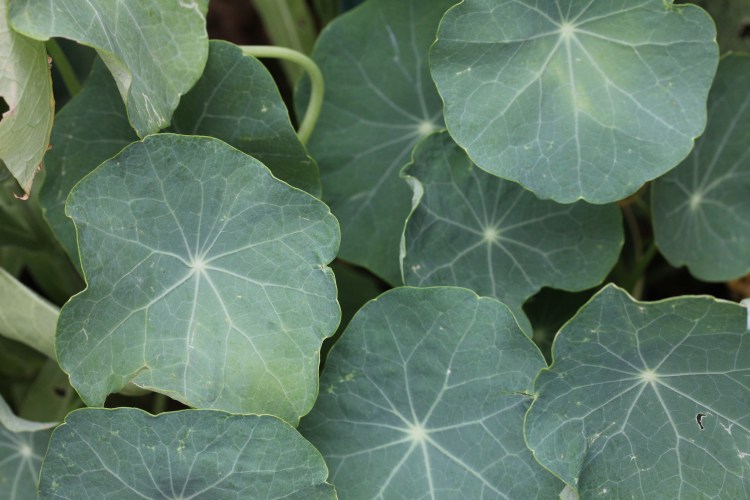
Nasturtium is an annual plant that is cultivated all over the world. Comes in both bush and trailing varieties. Thin, succulent , branching ,stems can grow at long as 10 feet. Leaves can be various sizes depending on the cultivar. These are alternate, round, radially veinated/palmately lobed with slightly scalloped or ruffled edges. Flowers come in shades of red, orange and yellow. These are set on the ends of long stalks in the axis of leaves. Each is funnel shaped with a frilly/clawed interior. There are five sepals/petals, with the topmost ending in a nectar spur. The “naked” fruit is a 1 -2cm, round, green ball that has 3 segments. Each of these contains a seed.

This plant has strong expectorant, anti-inflammatory, anti-viral, and anti-microbial, anti-oxidant and disinfecting properties. Its peppery, mustard like compounds clear the lungs, sinuses and other respiratory passages. It increases circulation to the organs and tissues. Its warming action will clear cold and damp. Herbalists have used this plant to treat persistent or secondary infections of all kinds. Nasturtium has a history of treating chest colds, flu, bronchitis, sinus infections, middle ear infections, muscle pain, cancer, high cholesterol, high blood pressure, osteoporosis, obesity, urinary tract/kidney infection, constipation, wounds, blisters, acne, edema, arthritis, yeast infections, athletes foot, and hair loss, This herb is thought to be helpful in the formation of red blood cells. It can be taken daily without disputing gut flora or creating anti-biotic resistance. Nasturtium is high in vitamin C.

Latin Name: Tropaeolum majus

Botanical family: Tropaeolaceae or Braassicaseae (cabbage)

Parts Used: flowers, leaves, fruit

Energetics: warming, pungent

Spiritual and Emotional Uses: to bring balance , warmth, vitality, and creativity back into one’s life. Supports increased energy, rejuvenation, and reconnection to the heart or nature.

Contraindications: Should not be used by those with kidney disease or ulcers. The plant contains “mustard oil” which can irritate the skin of sensitive individuals.

HOPS Salt

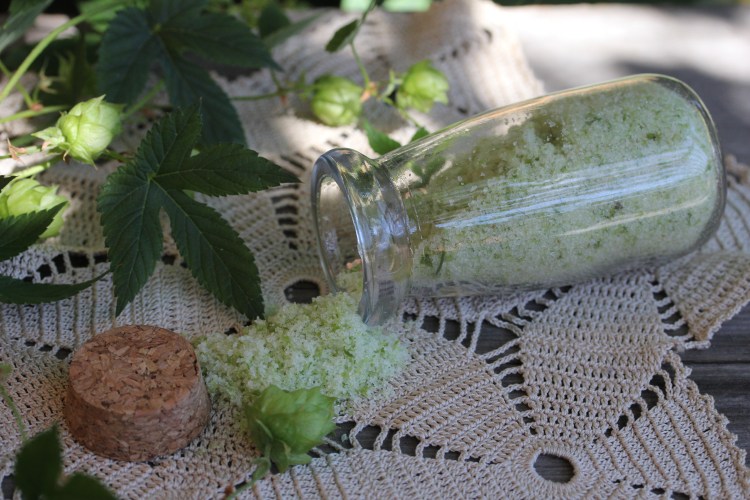
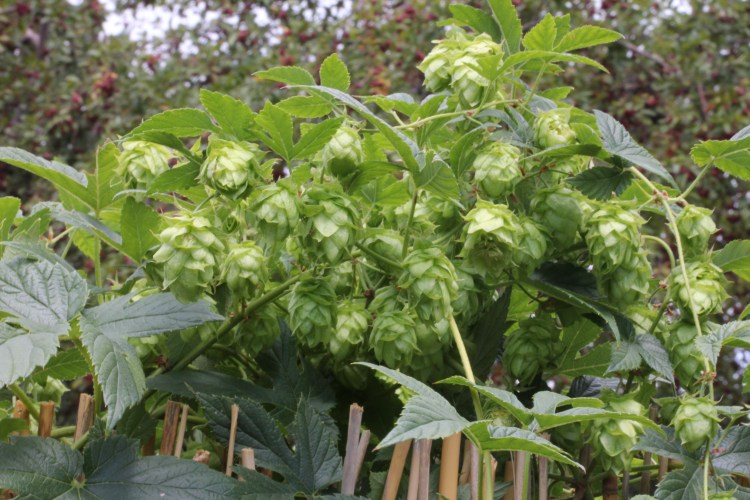
In the summer of 2021 I planted a hops plant. It grew maybe half a foot. Over the summer of 2022 it took off, requiring a trellis to support its lushness. I harvested so many of those “flowers” when they were still a vibrant green. Once dried they even stayed that color. Just harvested or even quickly dried hops smells amazing and has citrus/pine notes. It is nothing like what you would buy in a store or on-line. Fresh picked “cones” makes a lovely cup of tea with the addition of a bit of milk. I quickly became addicted to this afternoon beverage. I find myself still craving it long after the fresh hops is gone. If hops is not quite to your taste you can adapt a chai recipe to make it more palatable.

At first I put the dried “flowers” in several bath formulas for sleep and relaxation (dream pillows, baths, steams). Hops is pretty bitter, so unless you like beer–you won’t be picking much other than to make a batch tincture, which could last you for years. I did some research, looking for creative ways to use up the fresh hops so that it would not go to waste. I came across a recipe for hops salt. It is pretty tasty. Salt is a natural, long term preservative. It is an easy and palatable way to take small amounts of medicinal herbs on a regular basis. Experimenting with salts can expand how you use culinary herbs like fresh basil, nasturtium leaves, fennel, dill, rosemary or thyme. A small sprinkle goes a long way on grains, roasted vegetables, or proteins. Salt brings out and strengthens any floral notes or volatile oils. Your dinner guests will wonder what is creating that very subtle flavor of “citrus” or “pine”. Herbal salts and are very easy to make.

Hops Salt Recipe

Place 1 cup of white sea salt into a food processor. Add a handful or 1 cup of loosely packed fresh herbs. Blend until your product is of a uniform color and texture. This breaks down any pigments. You will have a brightly colored salt for a few days before it fades to an olive green.

In spring the perennial rootstock of hops will send up several spiny, woody, angular stems/shoots that can be up to 20 ft. long. These “vines” like to climb, twist and attach. Hops is known for its “aggressive” and smothering growth. Leaves are darker green, rough, cordate, serrate, opposite, palmate, with 3-5 lobes. These grow on long stems from off of the vines. Flowers are quite small, without petals, and grow in clusters on separate plants. Male flowers are small panicles/racemes appearing early in the summer. Female flowers, are catkins. These grow in size to form numerous, larger, vibrant green, highly aromatic “flowers”/strobiles with overlapping layers of bracts/scales (technically a cone shape fruit). Hops can be found growing in hedges, in the woods and sometimes along a stream as it prefers damp soil. It does well cultivated in the garden.

Hops has been used to treat insomnia, stress, muscle tension, anxiety, restlessness, hyperactivity, headaches, pain, fever, low milk supply, mastitis, menstrual problems due to low estrogen, hot flashes, menopausal symptoms, poor appetite, diarrhea, gas, IBS, Chrone’s disease, inflammation, digestive tract infection, ulcers, and rheumatism . As a bitter, it supports the liver, spleen and digestive system. Hops is a good diuretic for several conditions like cystitis, edema/water retention and kidney stones. Its antispasmodic properties make it useful for coughs and gastrointestinal spasm. Externally it has been used to treat dandruff, eczema, acne, boils, rough skin, rashes, growths, sprains, abscesses, bruises and wounds. A poultice can be helpful for headache and earache. The vines have been used to make cord, cloth and paper just like hemp which is in the same botanical family. Hops could also be used as a source of pectin.

Latin name: Humulus lupulus

Botanical Family: Cannabidacae

Parts Used: female cones/strobiles “flowers”

Energetics: cold, dry, bitter, pungent

Element: air

Spiritual Uses: To support our efforts when we need to achieve a goal. Helps us to develop patience, cooperation and perseverance. Some things take a long time to manifest. Be open and receptive as often the unexpected/unwanted can be the most beneficial to us in the moment. Reminds us that giving and receiving must come from the heart. Encourages us to share ourselves with the community. But with the caution that any gift should be truly needed and requested by the receiver. This prevents energy depletion and resentment. Calming when one fears loss. Sometimes we need to loose everything in order to gain what we most want.

Contraindications: Do not use during pregnancy. Because of its sedative effect hops may not be appropriate for those with a history of depression or the use of prescription sedatives. Can cause contact dermatitis or eye irritation in sensitive individuals. Caution is advised when harvesting, avoid contact with the vines or wear long sleeves and gloves. Dried hops that are several months old will have a stimulating effect. This herb has a history of suppressing menstruation in women and sex drive in men. Many not support those struggling with infertility. Prolonged high doses may stress the kidneys.

TULSI, Lemon and Ginger Syrup

A year ago I took a workshop on using medicinal herbs for trauma, grief and support for the dying. Tulsi (holy basil) was a popular recommendation in many of the suggested formulas. I have never been that drawn to experiment with tulsi since it is not commonly grown in the US. You can now find it easily in many well known commercial blends, but the tea has always seemed rather bland to me. Probably because of how it is dried and stored. It just seemed to be yet another plant from a far off country to become the next health trend (because it can be harvested in large amounts cheaply but unsustainably).

I decided to take the risk and order some dried tulsi from an on-line source. They had several sub species/varieties to choose from. I can only speak for the one I ordered. It has an amazing taste that is really hard to describe as there are so many “notes”(sweet, fruity, floral, spicy) that I can detect. Surprising given that the dried product I received had so little color and scent to it. I swoon to imagine what it would have been like as a living plant.

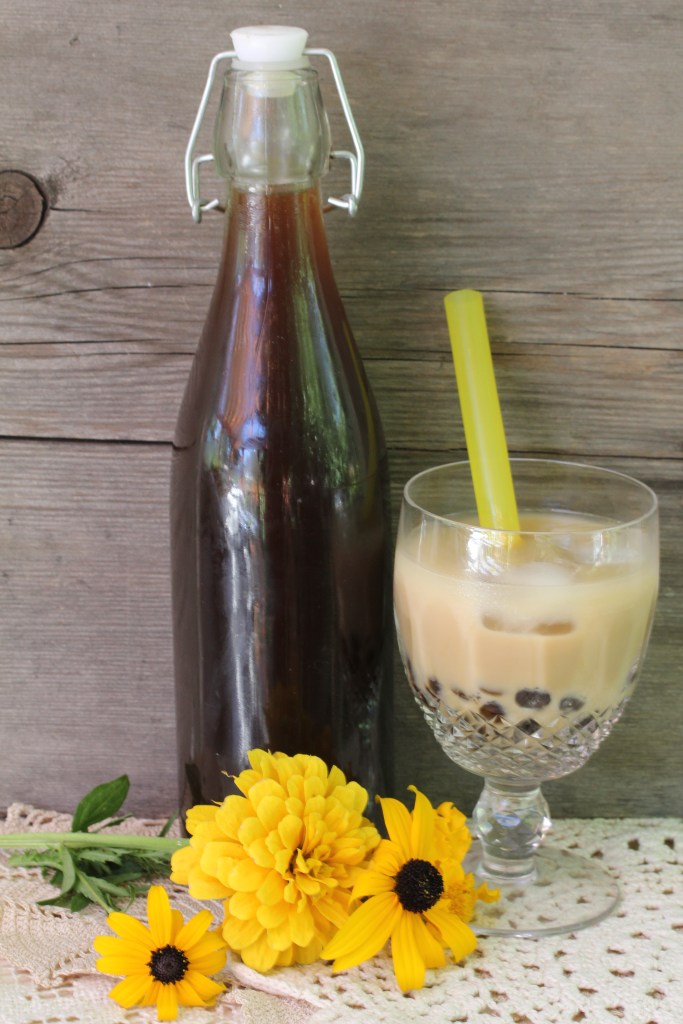
This tulsi syrup tastes a bit like Coke or Pepsi which originally had ingredients/essential oils such as neroli, cinnamon, orange, nutmeg, lavender, vanilla, and coriander. So far I have used it added to carbonated water, regular ice water, and to milk for a boba tea type drink. It has a rich caramel color just like other soft drinks but without all the bad stuff.

Tulsi Syrup

To a large stockpot add….

1 cup of coconut palm sugar

2 cups of water

1 medium lemon sliced into quarters

1/3 cup of dried tulsi leaves

1 inch of a large fresh ginger root coarsely chopped.

Bring to a boil, reduce to low heat, and simmer for 30 minutes.

Lastly-strain, fully cool, pour into bottles, cap and refrigerate. Will store for several months.

I have dozens of books on herbal medicine. Many of which are well known and popular. I also have a few books on Ayurveda. I was very disappointed that there was so little about tulsi in my home resources.

A far as a physical description, all varieties of basil will be frost tender annuals. Leaves will be oval shaped and opposite. These will not be downy. “Basil” leaves tend to be smooth and flat, same color top and bottom. Tulsi leaves will be much smaller than cultivated Italian basil, they may be slightly serrated. Tiny flowers will grow in whorled clusters or along a spike at the ends of stems past the large mature leaves. Light pink/purple or white petals are fused, the flower funnel shaped, with a large bottom lip. Hence why it is popular with bumble and native bees. Like other members of the “mint family” , tulsi will be high is volatile oils with a distinctive scent. It will have have square stems. Coloration of leaves and stems will vary just like other “mints” with lots of cultivated varieties. You may see hints of red or purple.

I have decided not to describe the medicinal qualities of tulsi as it it were Italian basil. You can read about that in other posts were I have featured that specific plant. Rather I will only list what is unique or special to tulsi based on internet research.

Tulsi reduces the inflammation associated with viral and bacterial infections. It is thought to purify the blood and remove serious toxins. This plant has a history of being used to treat heat conditions related to the eyes, skin, heart, liver or lungs. As herbal medicine it has been used for kidney stones, migraines, fevers, dental disease, gout, arthritis, stress, anxiety, fatigue, gas, bloating, parasites, poor appetite, ulcers, cancer, high blood pressure, high cholesterol, bronchitis, flu, allergies, asthma, swelling and pain. It may support weight loss by boosting metabolism. It may have anti-aging properties like reducing memory loss and boosting vitality.

As a poultice it has been used to remove venom from bites or stings. As an external wash it may help when there is acne, eczema, scars, hair loss, dandruff, rashes, fungal infections, and aging skin It can be burned as a disinfectant to purify or remove negative energy.

Latin name: Ocinum tenuiflorum/sanctum

Parts used: leaves and flowering tops

Energetics: pungent, bitter, warm, dry. In Ayurveda or vitalistic traditions, Tulsi is used to cool heat conditions.

Element: Fire

Spiritual/Emotional uses: Mastery and accomplishment through self control hard work and confidence. An expanded state of awareness that is positive, protective and supports achieving goals or manifesting dreams. Inspiration. To release any inner tension that constricts the spirit. Helps to increase self-esteem or courage. Can be used in a mild tea, external wash or bath to ease transitions or remove sorrow.

Contraindications: individuals experiencing diabetes, infertility, or who are pregnant. Large quantities may cause diarrhea and nausea.

Sage Cocktail Bitters

Bitters seem to be all the rage in any herb store or at local farmer’s markets. I have made a cacao based digestive bitter and a fruity thyroid support bitter. This was my first attempt at a “cocktail” bitter. We really don’t drink in my family. I will have to find some creative ways to use it up or give it to a friend who likes to experiment as a bartender for parties. I was inspired to make this due to an overabundance of sage and mugwort in the garden. Here we are in December. Both plants still have lots of lush, green growth that could be put to good use.

Sage Bitters

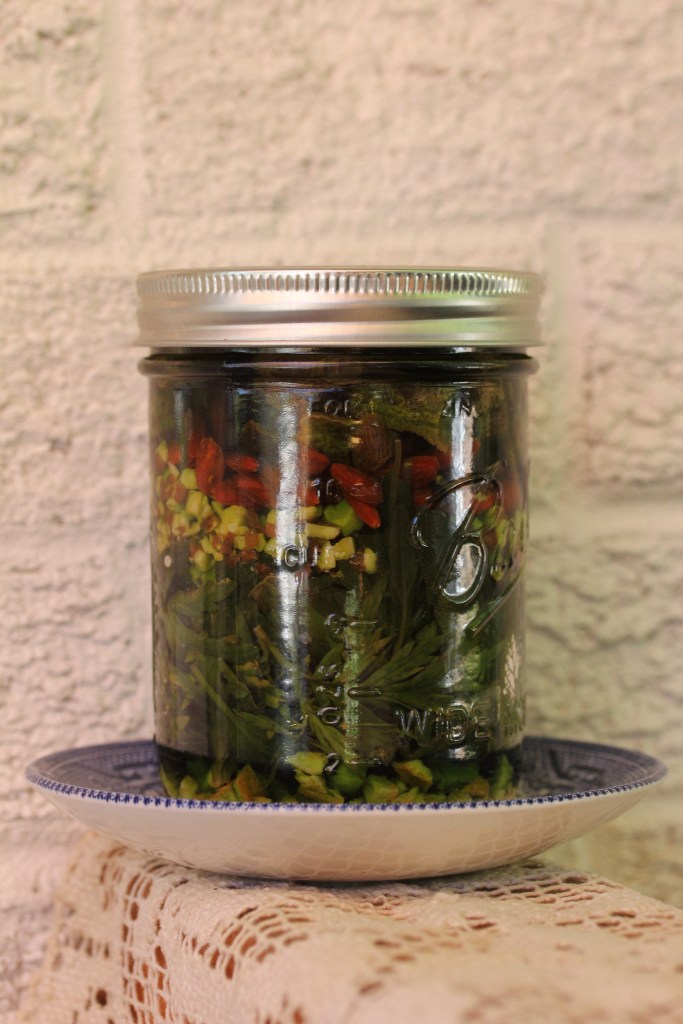
My ingredients of choice were fresh mugwort, dried orange peel, fresh sage, dried apricots, a vanilla bean, pecans, and dried gogi berries.

The base of any cocktail bitter recipe is….

1 part fresh herbs. Some amount of your choice of Bitter/Digestives-vervain, mugwort, angelica, lovage, or dandelion are possibilities. Other ones-sage, or rosemary

2 parts Everclear brand grain alcohol

Now this this is the artistic part where the herbalist gets to experiment with flavors and proportions. It is a very personal creation. Any good bitter contains some amount of the following…..

Dried fruit-cherries, apples, apricots, goji berries, golden raisins, figs

Frangrant spices-cardamon, cinnamon, cloves, ginger, nutmeg, vanilla bean, orange peel

Nuts-almonds, walnuts, peacans

As you chose think about which ingredients might pair well together. What level of sweetness, astringency or bitter appeals to your tastes. Consider favorite foods, smells, or memories.

Place all your ingredients in the appropriate size canning jar and seal with a lid.

Allow your bitter to sit 4-6 weeks. Then strain and bottle. Use as appropriate with personal discretion.

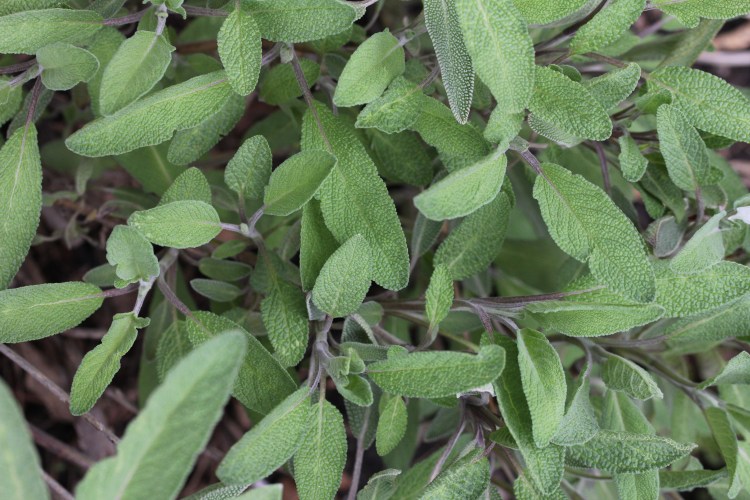
Sage is a shrubby perennial that is native to Europe. It grows well and overwinters even in my climate. In any garden that I have had it establishes itself as a “mother plant”. The stems are square, woody, long, finely haired and often leggy. With time and age my plants become less attractive but more productive in leaves. This herb can be sensitive. If you offend it, neglect it, damage it when harvesting-you may not see it the following year. The downy, oval shaped, crenated, opposite arranged leaves have a “sage” green color. The flowers are purple (sometimes white) tube shaped, two lipped, and grow widely spaced on terminal racemes. High in aromatic essential oils and botanical features clearly place it in the mint family.

Salvia is thought to be good for stress, depression, vertigo, hot flashes, digestive issues, gas, diarrhea, headaches, flu, congestion, menstrual problems, arthritis pain, blood clots, fever, and staph infections. She is a wonderful gargle for laryngitis, gum disease, bad breath, and sore throats. If you need to clear phlegm in any organ this plant is a good choice. As a bath Sage has been used externally to address eczema, insect bites, wounds, acne, rashes, and poison ivy/oak, dandruff, and vaginal discharge. There is a long history of using this plant as a symbol of wisdom, clarity, longevity, purification and protection. I like hanging bundles of the fresh herb in my house, washing the floors with the tea, or burning dried leaves to clean out energy from a space.

Parts used: Leaves

Energetics:bitter, dry, pungent, warming

Element:air

Spiritual/Emotional Uses-to remove negative energy, disturbances and bad luck. Helpful when one is struggling with the natural process of aging.

Contraindications:Large does in pregnancy. Do not use while nursing as it may dry up your milk supply. Do not use in therapeutic doses long term